Pennsylvania Gaming Regulation: How to Verify Online Casinos and Licenses

In short
Pennsylvania online casinos are regulated by the Pennsylvania Gaming Control Board. Before you deposit, check the exact brand on the Board’s current iGaming list, confirm that the app or website matches the authorized entry, and make sure you are 21 or older and physically located in Pennsylvania. A logo alone is not enough.
- The Pennsylvania Gaming Control Board regulates online casino-style gaming, casinos, sports wagering, fantasy contests, and other authorized gambling categories in Pennsylvania.
- Pennsylvania law permits interactive gaming only for registered players aged 21 or older who are physically located in the Commonwealth, subject to limited statutory exceptions.
- The current PGCB licensed online gaming operators page is the first record to check when a casino advertises to Pennsylvania players.
- For an unresolved online-gaming dispute, the PGCB says you must first complain to the licensed operator and obtain its complaint or ticket number before filing with the Board.
Table of contents
- Who regulates online casinos in Pennsylvania?
- How can you verify an online casino in Pennsylvania before depositing?
- What should you check beyond a Pennsylvania Gaming Control Board logo?
- What can you do if a Pennsylvania online casino dispute is unresolved?
- How much does a PA gaming license cost?
- Can I go to a casino at 18 in PA?
- What other Pennsylvania gaming questions come up most often?
- What is the safest next step before you deposit?
Who regulates online casinos in Pennsylvania?
The Pennsylvania Gaming Control Board, usually shortened to PGCB, regulates online casino-style gaming in Pennsylvania. The Board is an independent state agency created under Pennsylvania gaming law, and its remit includes casinos, online casino-type gaming, retail and online sports wagering, video gaming terminals, and fantasy contests. PGCB’s gaming overview sets out those responsibilities.
For a player, the practical point is simple: an online casino is not Pennsylvania-authorized because an ad says it is, because a familiar brand runs it elsewhere, or because its website displays a regulatory-looking badge. Pennsylvania authorization is a question for the PGCB’s current records.
The Board’s records can look more administrative than glamorous. That is a feature, not a bug. Marketing pages are designed to persuade; regulator records are designed to identify who has authority to offer a product.
If a casino names a regulator outside Pennsylvania, treat that as a separate claim. A reference to the Curaçao Gaming Authority does not confirm authorization for Pennsylvania play. Likewise, a reference to New Jersey’s division of gaming enforcement, explained, calls for a separate jurisdiction-specific check.
Pennsylvania authorization begins with the PGCB, not with a casino’s advertising language.
How can you verify an online casino in Pennsylvania before depositing?
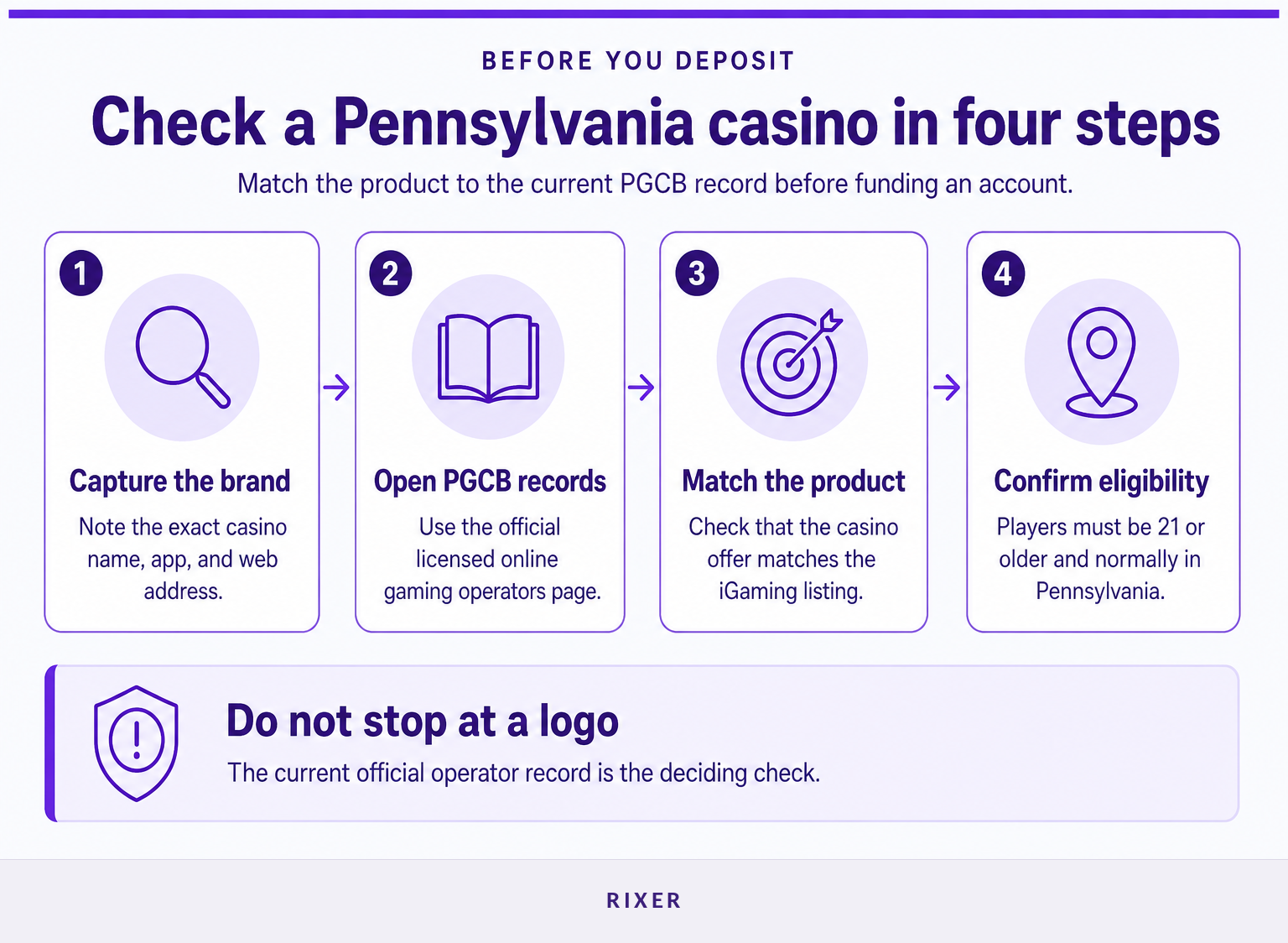
Verify a Pennsylvania online casino by checking the current PGCB iGaming record first, then matching the brand and product you intend to use. After that, confirm the player rules: you must be at least 21 and physically in Pennsylvania when participating in interactive gaming.
Here is the shortest useful verification routine.
- Write down the exact brand, app, and web address. Similar names are common, and a brand name alone may not tell you which product or jurisdiction you are looking at.
- Open the PGCB’s licensed online gaming operators page. Use the iGaming category for online casino-style games, rather than assuming a sports wagering or fantasy listing covers casino games too.
- Match the listing to the product. Check that the brand and the casino app or site you found correspond with the current official Pennsylvania listing. If the list does not resolve the question, pause before depositing and seek clarification from the PGCB or the operator.
- Check eligibility before creating an account. Title 4 of the Pennsylvania Consolidated Statutes says a player must be 21 or older and, except for limited reciprocal-agreement situations, physically located within Pennsylvania to participate in interactive gaming. The law also requires identity, age, and location checks. Title 4, Chapter 13B is the controlling source.
A useful second pass is to check the stated operating company and licensing history. Our licensing-authority directory is built for that kind of record check, but it should support, never replace, the PGCB’s own listing.
Do not rush this step because a promotion has a countdown clock. A regulated operator will still be regulated after you take five minutes to verify it.
Pennsylvania online-casino verification is a record-matching exercise: brand, product category, official PGCB listing, age, and current location must line up.
What should you check beyond a Pennsylvania Gaming Control Board logo?
A PGCB logo can be a useful supporting signal, but the official operator list is the deciding check. You should also confirm that the casino product is the one authorized in Pennsylvania and that your own account meets the state’s age and location conditions.
The clearest red flags are mismatches, not a single dramatic warning. For example, pause if an advertisement says “Pennsylvania” but the brand is absent from the current iGaming list, the product is listed only in another category, the address redirects to an unfamiliar site, or the casino cannot plainly identify the company behind the brand.
Location checks are not a minor technicality. Pennsylvania law generally requires a registered interactive-gaming player to be physically in the Commonwealth. PGCB technical standards require location detection when a player logs in or makes an initial wager and periodic re-checks during a session. PGCB geolocation technical standards describe those requirements.
Keep the categories separate. A site authorized for online sports wagering is not automatically an authorized online casino, and an overseas license claim is not the same thing as appearing on the PGCB’s Pennsylvania iGaming list.
The safest check is not “Does this site look official?” but “Can I match this exact product to the PGCB’s current record?”
What can you do if a Pennsylvania online casino dispute is unresolved?
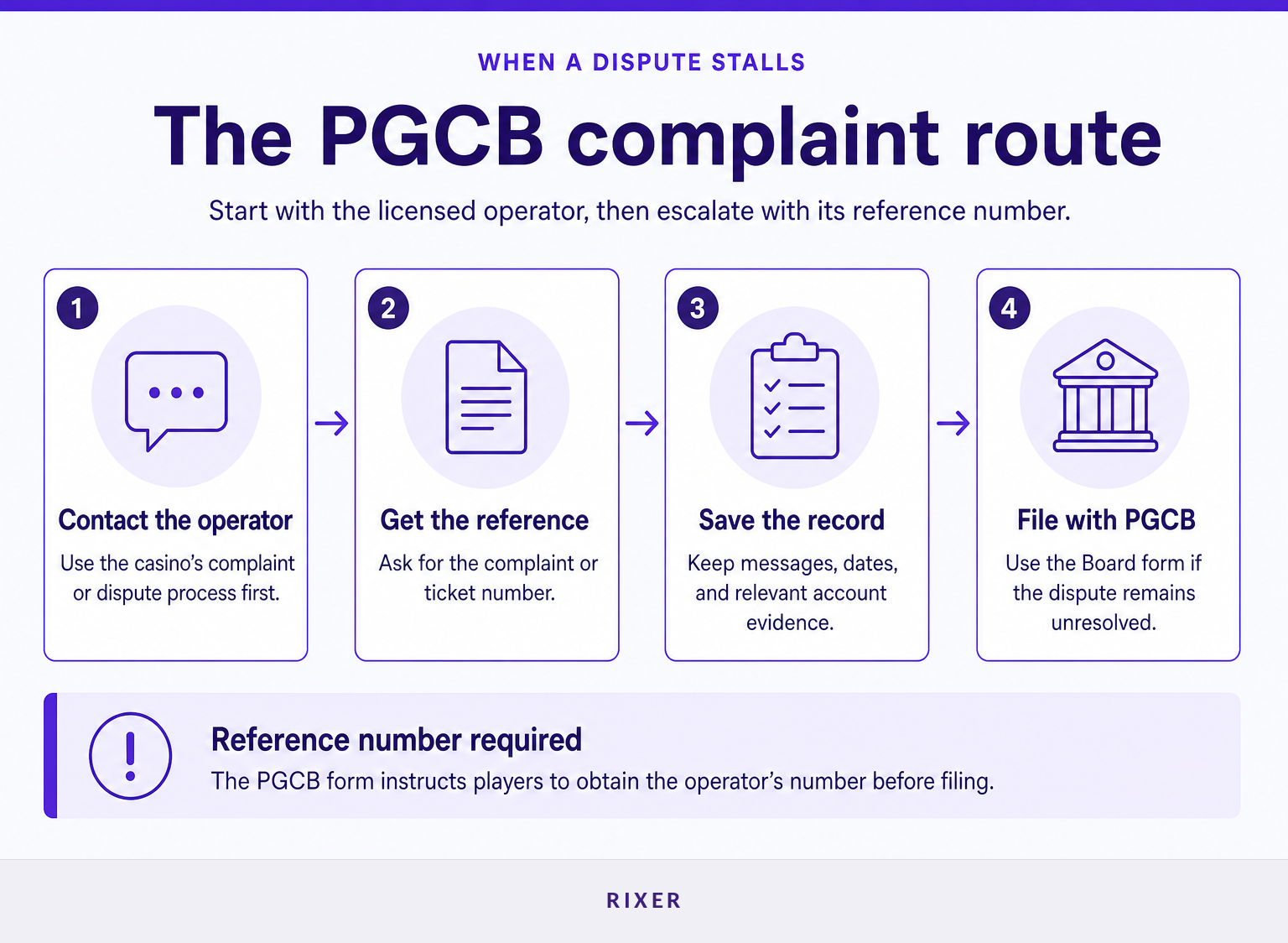
Start with the licensed operator’s own complaint route and ask for a complaint or ticket number. If the matter remains unresolved, the PGCB’s patron complaint process requires that operator reference before you submit a complaint to the Board.
The PGCB patron complaint form says the sequence is mandatory for interactive gaming, online sportsbook, fantasy-contest, and live-dealer disputes: complain to the operator first, receive a ticket or complaint number, then complete the Board’s form.
Keep a clean file while the facts are fresh:
- The operator’s complaint or ticket number
- Dates and times of chats, emails, deposits, withdrawals, or account restrictions
- Screenshots of relevant account messages and terms that applied at the time
- The casino brand, app, web address, and any stated operating company
- A short timeline that separates what happened from what you think should happen next
The PGCB route is about a regulated Pennsylvania product. If you cannot verify that a site is PGCB-authorized, the Board may not be the right regulator for that site. That is another reason to do the license check before a dispute turns into a scavenger hunt.
If gambling is becoming hard to control, the PGCB offers self-exclusion options covering casinos and interactive gaming through its compulsive and problem gambling resources.
For a Pennsylvania-regulated casino dispute, complain to the operator first, preserve its reference number, and then use the PGCB process if the complaint remains unresolved.
How much does a PA gaming license cost?
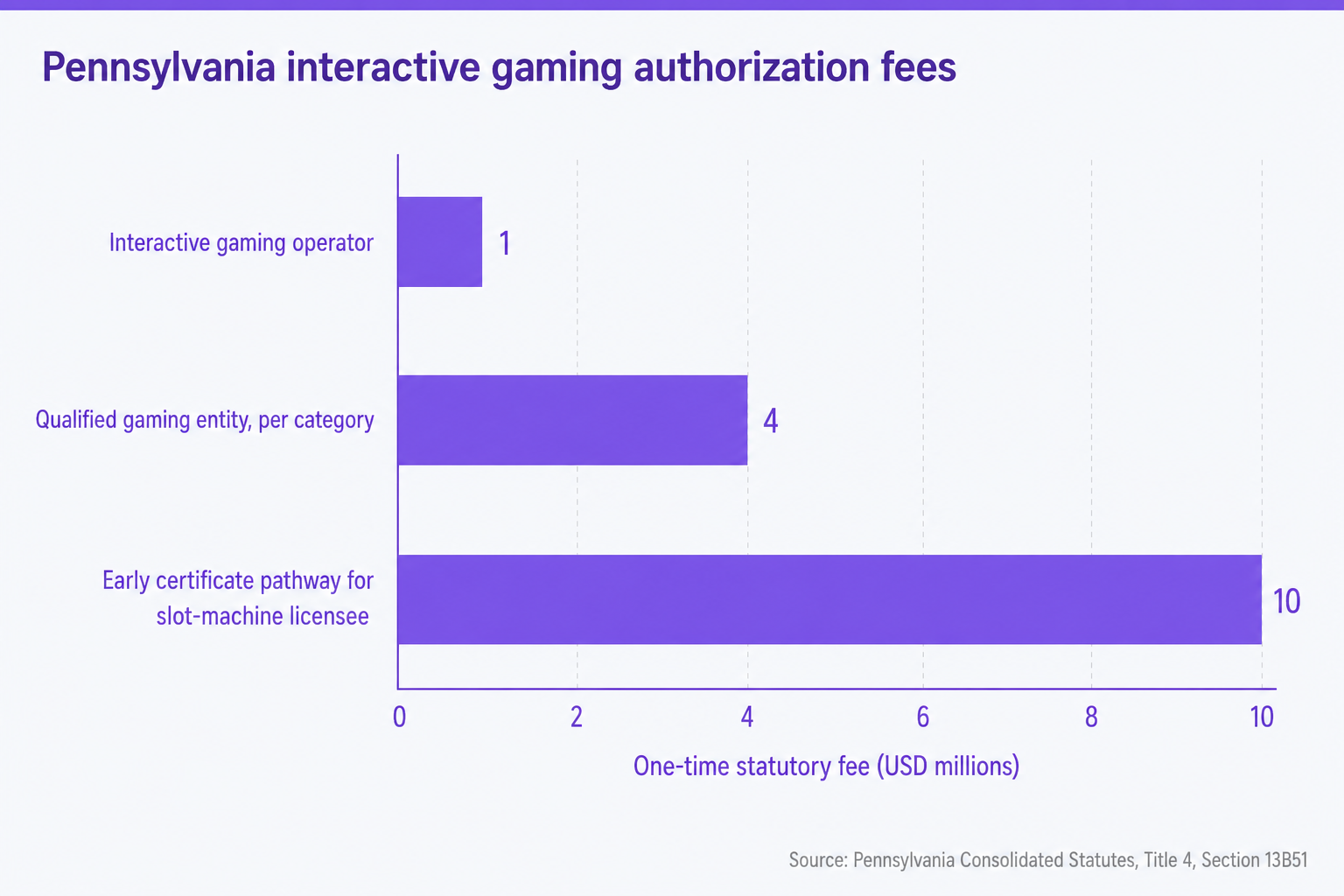
PA gaming license costs depend on what is being licensed, so there is no single price for every casino-related business. For interactive gaming, Pennsylvania law lists a $1 million one-time authorization fee for an interactive gaming operator, while some certificate pathways carry $4 million per authorized game category or a timing-dependent $10 million fee for slot-machine licensees.
These are operator and certificate-holder authorization costs, not fees charged to players. Section 13B51 also lists renewal fees of $100,000 for an interactive gaming operator license and $250,000 for an interactive gaming certificate. Read the current statutory wording in Title 4, Section 13B51 because eligibility and timing determine which route applies.
The price of a license does not tell a player whether a particular app is currently authorized. The current PGCB operator record does.
Can I go to a casino at 18 in PA?
No, not to gamble in a Pennsylvania casino or to use an interactive-gaming account. Pennsylvania law makes it unlawful for someone under 21 to wager or attempt to play a slot machine, table game, or interactive game, and it prohibits under-21s from opening, maintaining, or using an interactive-gaming account.
The relevant rule appears in Title 4, Section 1518. There are narrow employment-related provisions about access to gaming areas, but those do not permit an 18-year-old to gamble.
For online casino-style gaming, age is only one part of eligibility. The player must also be a registered account holder and normally be physically within Pennsylvania at the time of play.
In Pennsylvania, 21 is the gambling age for casino slot games, table games, and interactive casino gaming.
What other Pennsylvania gaming questions come up most often?
How much does a PA gaming license cost?
PA gaming license cost depends on the authorization route. Title 4 lists a $1 million one-time fee for an interactive gaming operator, $4 million per authorized category for a qualified gaming entity, and certain slot-machine-licensee certificate routes with $4 million or $10 million fees tied to filing timing. Those are business authorization fees, not player costs.
What casinos can you play online in PA?
The current answer changes as brands enter, leave, or alter their Pennsylvania offerings. Check the PGCB’s live licensed online gaming operators page and use its iGaming category for online casino-style games. A brand that operates elsewhere should not be treated as available or authorized in Pennsylvania unless the current PGCB record supports it.
Can I go to a casino at 18 in PA?
No. Pennsylvania law requires a person to be at least 21 to wager or attempt to play slot machines, table games, or interactive games. The same law bars anyone under 21 from opening, maintaining, or using an interactive-gaming account. Employment exceptions for access to some gaming areas do not create a right to gamble.
The practical answers stay consistent: use the live PGCB list for authorization, use the statute for age rules, and do not rely on advertising alone.
What is the safest next step before you deposit?
Run the exact casino brand through Rixer’s casino verification lookup, then compare what you find with the PGCB’s live operator list. If the ownership, product, jurisdiction, or authorization trail is unclear, the safe decision is to wait rather than fund an account you cannot confidently identify.
Check a casino before you deposit
The licence, who really owns it, and whether it takes players from your country — with the evidence and the date we looked.