Division of Gaming Enforcement: License Checks, Complaints, and Official Records

In short
A Division of Gaming Enforcement is not a single global casino regulator. The correct agency depends on the jurisdiction and the type of issue: in New Jersey, the Division of Gaming Enforcement accepts casino patron complaints and internet-gaming disputes, while official licensing information is also published through the Casino Control Commission.
Key takeaways
- A regulator's name alone does not prove that a casino is licensed for your location, so check the exact legal entity, website domain, and official record.
- New Jersey uses a two-agency system: the Casino Control Commission makes licensing decisions, while the Division of Gaming Enforcement investigates, regulates operations, and handles patron complaints.
- New Jersey's internet-gaming dispute route is for unresolved problems with New Jersey permit holders, not a universal complaint channel for every gambling website.
- Florida's Division of Gaming Enforcement focuses on illegal gambling activity, including unlawful online gambling, which is different from resolving a routine player account dispute.
- Keep the operator's response and relevant documents before escalating a complaint, and never send passwords, payment-card numbers, or other sensitive credentials by email.
Contents
- Is a Division of Gaming Enforcement the regulator you need?
- How do you verify a casino license?
- Where can I find the NJ DGE complaint form?
- Who investigates online casinos?
- Who has the power to regulate gambling?
- Frequently asked questions
Search results for “Division of Gaming Enforcement” often mix New Jersey complaint pages, Florida illegal-gambling enforcement, Louisiana licensing operations, and even revenue announcements. The shared name is the trap. Before you file a form or rely on a logo, identify the jurisdiction that actually governs the gambling activity.
Is a Division of Gaming Enforcement the regulator you need?
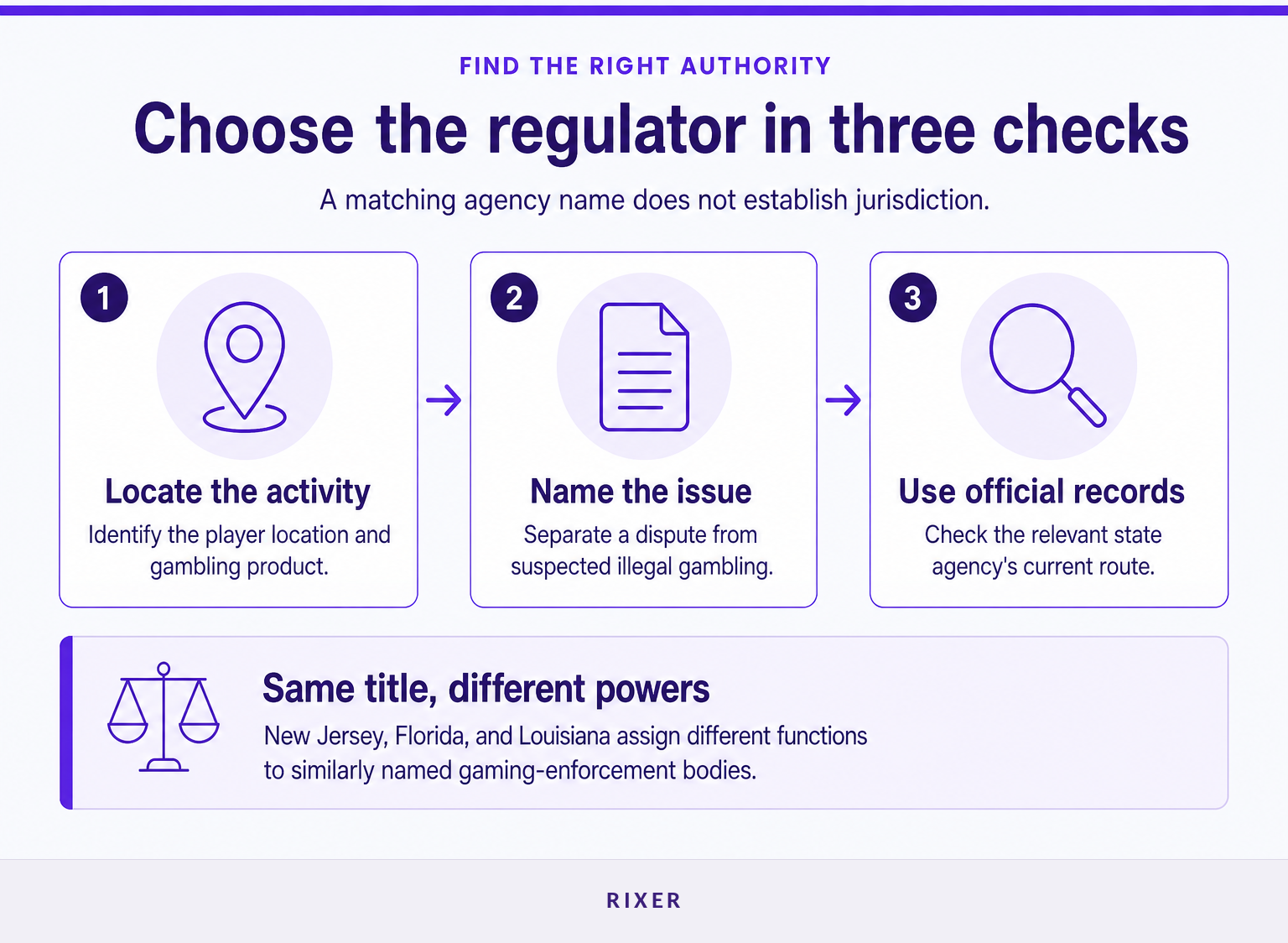
A Division of Gaming Enforcement is usually a state-level body, not an international authority over every online casino. Its powers come from the laws of its own jurisdiction, so the agency named on a casino site may not be the agency that can deal with your issue.
New Jersey is the result most people mean when they search this exact term. The New Jersey Casino Control Commission says the state uses a two-agency system: the Commission is the independent decision-making body for casino licensing, while the Division of Gaming Enforcement, part of the Attorney General's Office, provides law-enforcement supervision of casino operations and related service industries. The Commission's own FAQ adds that the Division investigates casino and key-employee applicants, regulates Atlantic City casino operations, registers employees and vendors, and enforces casino-gaming laws and regulations. Casino Gaming in New Jersey and the Commission's FAQ are the right starting points for the split of responsibilities.
The same title can mean something narrower elsewhere. Florida's Division of Gaming Enforcement describes itself as a statewide law-enforcement agency dedicated to investigating illegal gambling operations, including unlawful online gambling. Louisiana's Gaming Enforcement Division, by contrast, says its Operations Section oversees licensed casinos and gaming establishments and processes licensing or permit applications. The name alone tells you very little. Florida's enforcement priorities and Louisiana's Gaming Operations section show why jurisdiction comes first.
The useful question is not “Does this casino mention a regulator?” It is “Which authority governs this exact operator, website, product, and player location?”
How do you verify a casino license?
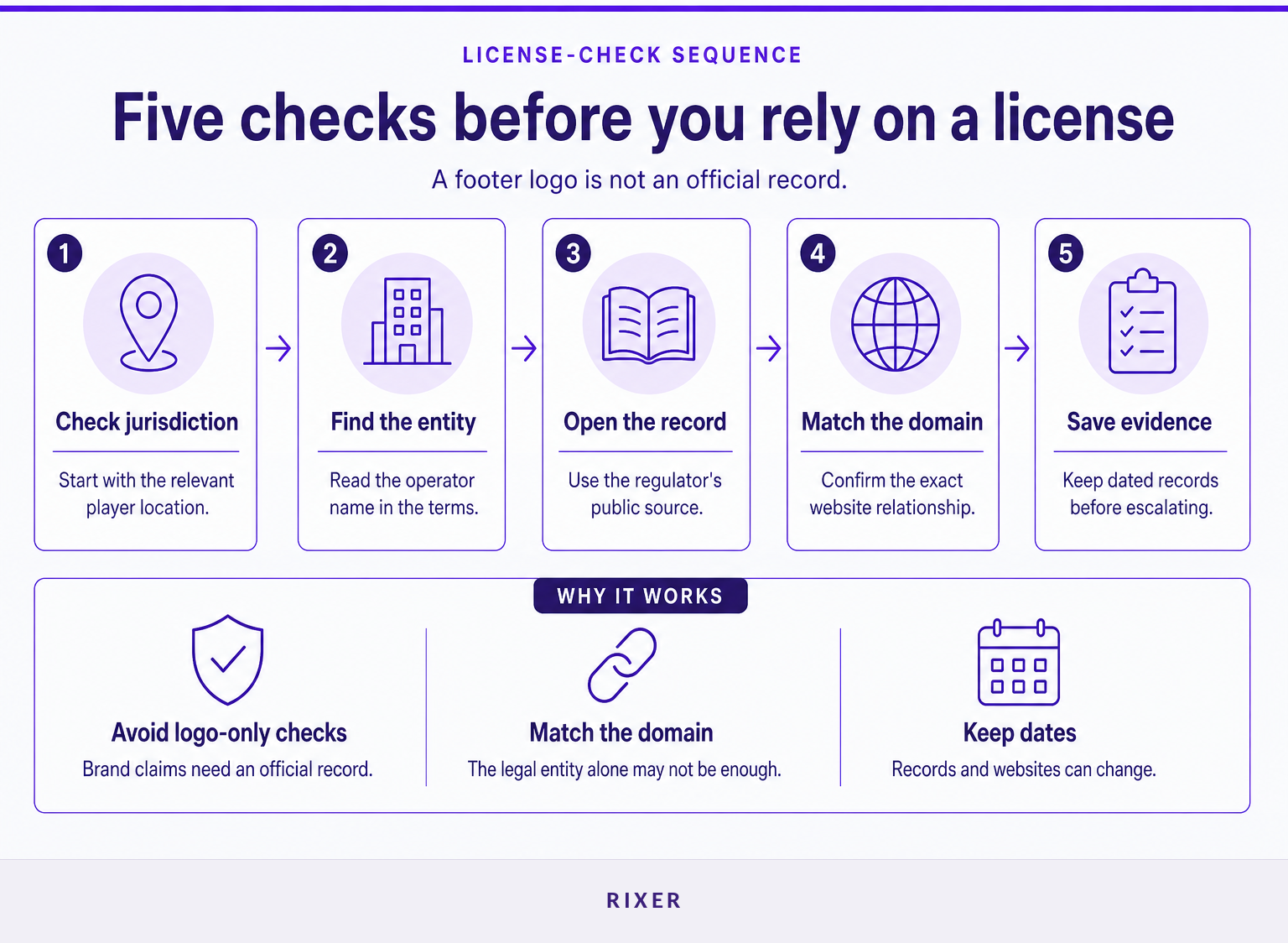
Verify a casino license through the regulator's own records, not through a logo in the casino footer. Match the legal entity and the exact website domain to an official record, then check whether that record covers the gambling product and jurisdiction relevant to you.
Start with the identity behind the brand. A website name, app name, payment descriptor, company name in the terms, and customer-support email may all be different clues. If those clues do not line up, pause before depositing or escalating a dispute.
For New Jersey, the Casino Control Commission's open-data catalog points readers to information on licensed casino hotels and internet-gaming affiliates, while its licensing pages publish selected licensing reports and explain the application structure. These are official records, but they answer different questions. A casino-hotel license, a key-employee list, and an internet-gaming affiliate record are not interchangeable.
Use Rixer's licensing-authority directory to identify the authority a casino says licenses it, then use the regulator's official source to confirm the claim. If the brand is hard to identify, our license verification tool can help organize the basic checks before you decide whether an official complaint route is relevant.
A practical verification sequence looks like this:
- Identify your jurisdiction. Check where you are located and which regulator has authority over the product offered to you.
- Find the legal entity. Look for the operator name in the site's terms, privacy notice, or payment information.
- Use an official record. Search the named regulator's current public list, register, order, or approved-site page.
- Match the domain. A genuine company name is not enough if the website address does not match the official record or documented affiliate relationship.
- Save the evidence. Keep dated screenshots, transaction references, the operator's response, and the page showing the regulatory claim.
A license check is only as good as the match between the player location, legal entity, website domain, and official record.
Where can I find the NJ DGE complaint form?
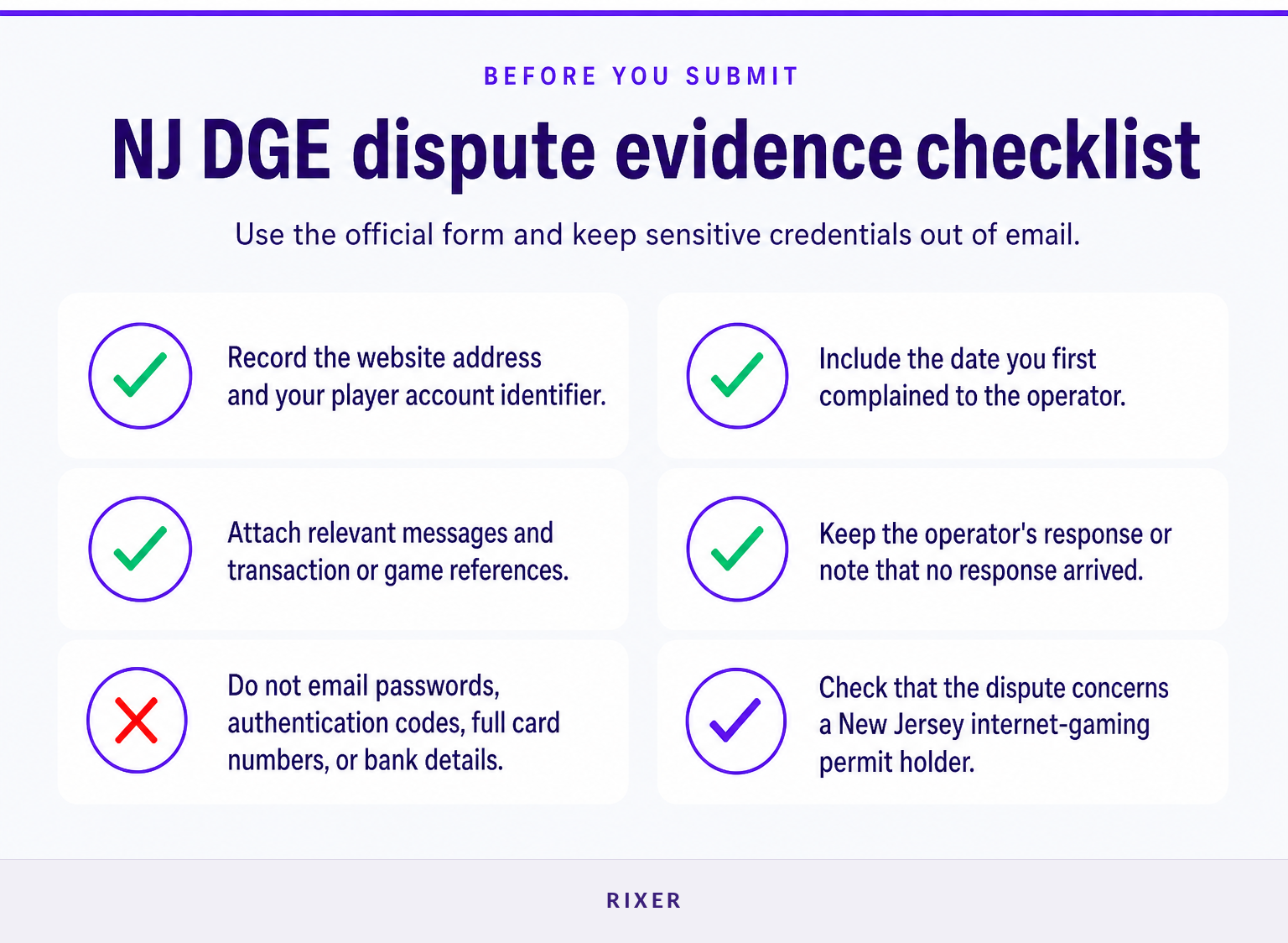
The New Jersey Division of Gaming Enforcement publishes an Internet Gaming Dispute Form for disputes involving New Jersey internet gaming. The form asks for the gambling website, the nature of the complaint, and the dates of your original complaint to the operator and its response.
That last detail matters. New Jersey's published internet-gaming rules describe escalation to the Division after reasonable efforts to resolve the matter with the licensee have been exhausted. The rules also require internet-gaming systems to explain how a patron can complain to the licensee and how an unresolved complaint may be filed with the Division. See the New Jersey internet-gaming regulations.
The form available from the New Jersey government site, checked in October 2026, instructs users to attach supporting documents but not to email personally identifiable information such as Social Security numbers, passport or driver's-license numbers, bank or payment-card numbers, passwords, or authentication credentials. Do not solve a dispute by sending the casino everything in your inbox. Send only the evidence the route requests, and redact sensitive information where possible.
What should you include in an NJ internet-gaming dispute?
An NJ DGE complaint should make the timeline easy to follow. Include your account identifier, the website address, transaction or game references, the date you first complained to the operator, the response received, and copies of relevant messages or records.
Keep the explanation factual: what happened, when it happened, what you asked the operator to do, and what response you received. Avoid sharing passwords or full financial-account details. If the issue involves immediate fraud, theft, or personal safety, use the appropriate law-enforcement or emergency route rather than waiting for a gambling-regulator process.
For an NJ DGE dispute, a dated operator complaint and a clear evidence trail matter more than a long account of frustration.
Who investigates online casinos?
The authority that investigates an online casino depends on what happened and where it happened. A licensed operator dispute, an allegedly false licensing claim, and suspected illegal online gambling can each belong to different bodies.
New Jersey's Casino Control Commission says the Division of Gaming Enforcement accepts patron complaints regarding Atlantic City casino facilities and disputes involving New Jersey internet-casino permit holders. That is a defined state route, not a promise that New Jersey can resolve every dispute with a website accessible from abroad. The Commission FAQ is the official source for that distinction.
Florida illustrates the other side of the line. Its Division of Gaming Enforcement says it identifies, investigates, and apprehends people, organizations, or businesses operating or promoting illegal online gambling. That enforcement remit can be relevant when reporting suspected unlawful activity, but it is not the same thing as a player dispute process for a delayed withdrawal or a support complaint. Florida's published priorities set out that focus.
Before escalating, check the casino's identity in a casino lookup, preserve the relevant records, and separate a suspected criminal or unlawful operation from a dispute with an identified regulated operator. Those are different paths.
The right investigator is determined by the conduct and jurisdiction, not by whichever regulator name appears first in a search result.
Who has the power to regulate gambling?
Gambling regulators receive their authority from the laws of a specific jurisdiction. Legislatures create the legal framework, and the agencies named in that framework license, investigate, inspect, enforce, hear appeals, or perform other assigned functions.
New Jersey makes the division visible. The Casino Control Commission handles licensing decisions and appeals, while the Division of Gaming Enforcement investigates applicants, regulates casino operations, handles relevant patron complaints, and enforces the casino-gaming rules. Louisiana's State Police Gaming Enforcement Division also describes licensing and enforcement responsibilities for specified Louisiana gambling sectors. Louisiana's gaming FAQ explains that casino disputes concerning rules and regulations can use a patron dispute form obtained from the casino and sent to the Division.
Do not assume that one state's regulator has authority over an operator because the operator's website is visible there. Regulatory authority is built from statutes, licenses, approvals, and the facts of the activity, not from search visibility.
The regulator with power is the one named by the law and official records governing the specific gambling activity, not a similarly named agency in another state.
Frequently asked questions
Who investigates online casinos?
Online casinos may be investigated by the gambling regulator, law-enforcement body, or consumer-protection authority with jurisdiction over the operator or activity. In New Jersey, the Division of Gaming Enforcement accepts disputes involving New Jersey internet-casino permit holders. Florida's Division of Gaming Enforcement focuses on illegal online gambling operations, which is a different type of case.
Where can I find the NJ DGE complaint form?
The NJ DGE Internet Gaming Dispute Form is published on the New Jersey government website. It asks for the website address, the complaint type, and the dates of your complaint to the operator and its response. New Jersey's rules describe filing with the Division after reasonable attempts to resolve the issue with the licensee.
Who has the power to regulate gambling?
The government body with power to regulate gambling is determined by the laws of the relevant jurisdiction. In New Jersey, the Casino Control Commission makes casino licensing decisions, while the Division of Gaming Enforcement investigates, regulates operations, handles relevant complaints, and enforces gaming laws. Other states assign these functions differently.
Check the record before you act
A regulator logo is not a license check, and a Division of Gaming Enforcement is not a universal complaint desk. Identify the jurisdiction, confirm the operator and domain in an official record, then choose the route that matches your problem. If you need a place to organize the first checks, use our casino lookup before you deposit or escalate.
Check a casino before you deposit
The licence, who really owns it, and whether it takes players from your country — with the evidence and the date we looked.