Low Volatility Slot Machines: What the Label Means and What It Does Not Guarantee

In short
Low volatility slot machines usually produce a less dramatic pattern of results: smaller prizes may appear more often, while very large prizes appear less often. That does not make a slot safer, improve its return to player, predict the next spin, or tell you whether the casino offering it deserves your trust.
- A low-volatility label describes the spread of a slot's results, not a promise that a player will win.
- RTP is a theoretical long-run design figure, while volatility describes how unevenly returns may arrive.
- Hit frequency can be higher in a low-volatility slot, yet a return can still be smaller than the stake placed.
- A low-volatility game and a trustworthy casino are separate checks: inspect the game information, then verify the operator, license claims, and public record.
Contents
- What does “low volatility” mean in a slot machine?
- Does low volatility make a slot safer or more likely to pay?
- How are volatility, RTP, hit frequency, and max win different?
- How can you find a genuinely low-volatility slot?
- Which slot machines are most likely to win?
- Is low volatility better?
- Frequently asked questions
- What should you check before playing a low-volatility slot?
What does “low volatility” mean in a slot machine?
A low-volatility slot is designed to produce a more even distribution of prizes than a high-volatility slot. In plain language, it commonly means smaller returns may occur more often and very large returns are less central to the game’s prize structure.
Volatility is not a universal rating scale. One provider may use three bands, another may use five lightning bolts, and another may show no public label at all. The United Kingdom Gambling Commission describes volatility as commonly represented by standard deviation: high-volatility games can contain very large but rare prizes, while low-volatility games are more predictable and mainly made up of small, frequent prizes. (gamblingcommission.gov.uk)
That description is useful, but the word predictable needs care. It describes the game’s overall prize distribution, not the outcome of your next spin. A sequence of losses can occur in a low-volatility slot, just as a larger result can occur in one.
If you are looking at physical machines, labels can be thinner still. Pay tables, prize schedules, and casino staff may provide context, but a machine’s look, denomination, or theme is not proof of volatility.
Low volatility is about the shape of possible results over time, not a promise about the next result.
Does low volatility make a slot safer or more likely to pay?
No. Low volatility does not make a slot safer, and it does not make the next spin more likely to pay than the game’s underlying design allows.
A game label answers a game-design question: how might returns be distributed? Casino safety is a separate operator question: who runs the site, what license does it claim, is it available where you live, and what evidence or complaints are on record?
A low-volatility title can still have a lower RTP than another game. It can also appear at a casino with weak ownership information, unclear licensing claims, or a poor public record. Conversely, a well-run casino can offer games across low, medium, and high volatility bands.
RTP does not change this. The Gambling Commission defines theoretical RTP as the designed return shown in player-facing rules, while actual RTP is calculated from live results during a selected period. Neither figure tells an individual player what will happen in one session. (gamblingcommission.gov.uk)
Before depositing, use a casino trust check for the operator and use the game’s information screen for the title. Those are two different jobs, and mixing them up is how a calm-looking game gets mistaken for a safety signal.
A low-volatility label describes a slot’s payout pattern, while casino safety depends on the business operating the game.
How are volatility, RTP, hit frequency, and max win different?
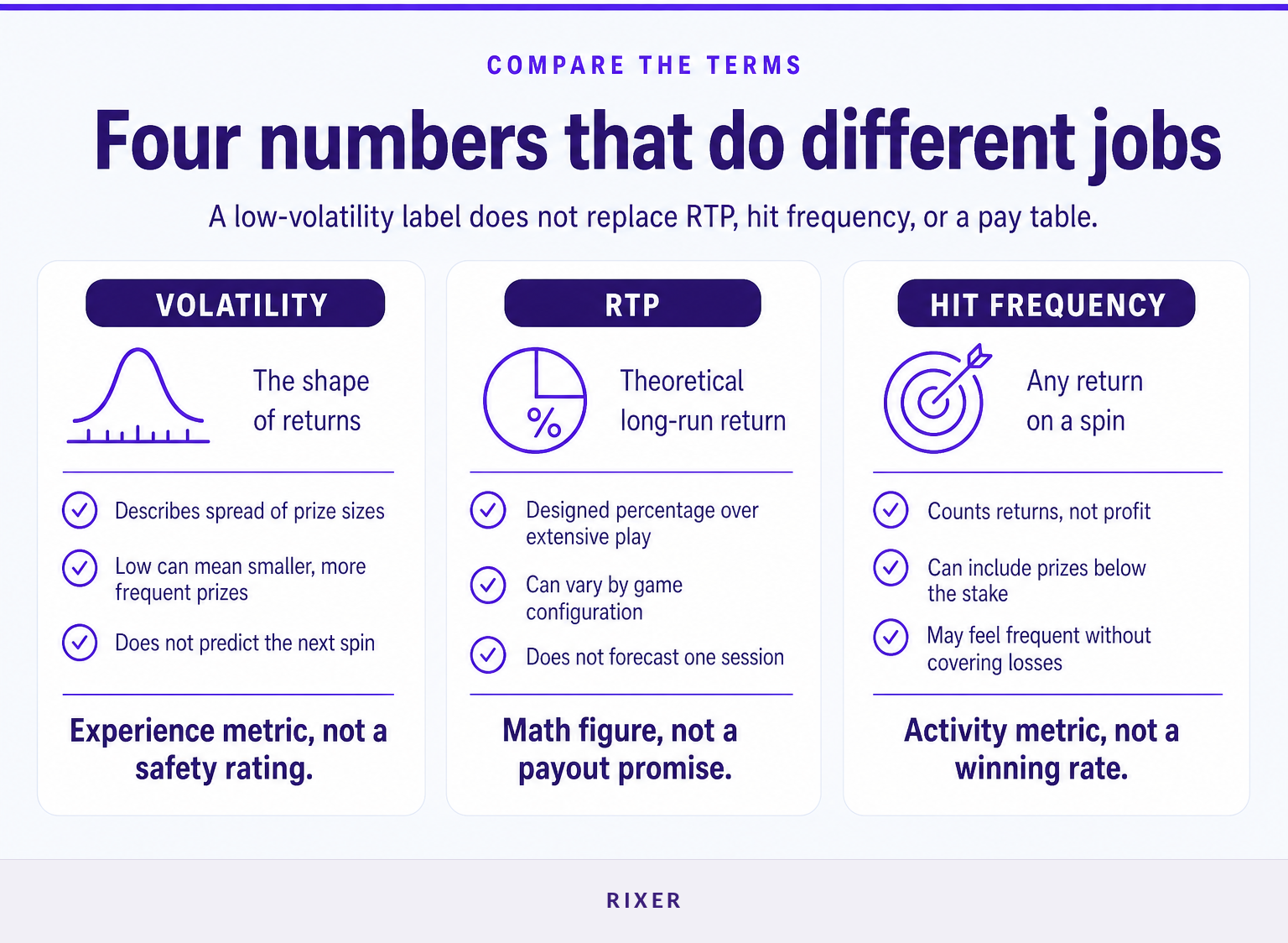
Volatility, RTP, hit frequency, and max win describe different parts of a slot game. Treating them as interchangeable is the fastest route to a bad comparison.
| Term | What it describes | What it cannot tell you |
|---|---|---|
| Volatility | How spread out prize sizes and timing may be | Whether the next spin wins |
| RTP | The game’s theoretical long-run return percentage | What one player will receive in one session |
| Hit frequency | How often a spin returns any prize | Whether that prize exceeds the stake |
| Max win | The largest advertised prize relative to stake | How likely that top prize is to occur |
Volatility concerns variance. A low-volatility game may create more modest returns, while a high-volatility game may concentrate more value in rare outcomes.
RTP is a long-run theoretical percentage. If a game is configured at 96% RTP, that does not mean a player who stakes $100 gets $96 back, or that 96 out of 100 spins pay. It describes the game’s designed return across an extremely large amount of play, subject to the version and configuration offered.
Hit frequency is often the most misunderstood term. It generally means the proportion of spins that return something, but that return may be smaller than the wager. UK Gambling Commission rules specifically prohibit licensed remote operators from celebrating a return that is less than or equal to the total stake, which helps explain why a screen can show activity without the game cycle being profitable. (gamblingcommission.gov.uk)
Max win is mainly a ceiling. A game advertised with a high maximum multiplier may still be low, medium, or high volatility depending on the wider math model.
The useful comparison is never one number alone: check the RTP configuration, volatility label, pay table, and your stake limit together.
How can you find a genuinely low-volatility slot?
Start with the game’s own information screen, then verify each label against the game version you can actually access. Do not rely on an old listicle, a search snippet, or a streamer’s result from a different casino.
Look for these details in order:
- Provider information: The game help screen may name its volatility band, show an icon scale, or explain prize behavior. A directory of game providers can help identify who made a title before you rely on information attributed to it.
- RTP setting: Some game titles can be supplied in more than one RTP configuration. Check the rules or information panel at the casino you are using, not only the provider’s promotional page.
- Pay table and features: A pay table will not calculate volatility for you, but it can show whether the game leans on regular line wins, bonus features, jackpots, or a small group of rare multipliers.
- Demo parity: A free version may be helpful for learning the layout, but confirm it represents the same real-money version. In the UK, play-for-free games must use an appropriate RNG and accurately represent the corresponding real-money prize distribution. (gamblingcommission.gov.uk)
- Casino verification: Once you have chosen a game, check the casino separately. Rixer’s evidence standards explain how the platform dates and labels claims rather than treating unknown information as a negative.
The label may not be perfect, but the game’s own rules and configuration are a much stronger starting point than a claim that one title is guaranteed to be gentle.
Which slot machines are most likely to win?
No slot machine can be identified as most likely to win on the next spin. Random game outcomes do not create a reliable shortlist of titles that are due to pay.
For eligible UK remote gambling, the Gambling Commission’s technical standards require player information about game rules and either house edge, RTP, or the probability of winning events. The standards also require testing and controls around random-number generation. (gamblingcommission.gov.uk)
That gives readers something useful to compare, but it is not a prediction engine. If two games have different RTPs, the higher theoretical RTP may be the better long-run mathematical figure if every other condition is equal. It does not tell you which one will pay during a short session, and it does not cancel the house edge.
Avoid claims that a low-volatility slot is “due,” “loose today,” or guaranteed to extend play. A slower-feeling loss pattern can still be a loss pattern.
No game is reliably due to win, so compare published rules and protect your budget instead of chasing a prediction.
Is low volatility better?
Low volatility is better only if you prefer smaller swings and understand that frequent returns can still fall below your stake. It is not objectively better than high volatility, and it does not improve a game’s expected return by itself.
A low-volatility game may suit an adult player who dislikes long quiet stretches and prefers a steadier pace. A high-volatility game may suit someone who accepts long losing runs in exchange for a prize structure that places more emphasis on rare large outcomes. Neither choice makes gambling low-risk.
The practical question is not “Which volatility is best?” It is “Which experience can I afford to stop playing when the budget is gone?” Set a fixed spending limit before starting, treat any return as uncertain, and leave the game when that limit is reached.
Low volatility is a preference about the ride, not a better route to profit.
Frequently asked questions
Which slot machines are most likely to win?
No slot machine is most likely to win on an individual next spin. A slot’s RTP, pay table, and volatility can describe long-run design and prize distribution, but random outcomes mean they cannot identify a game that is due to pay during your session. Treat claims of guaranteed winners with caution.
Is low volatility better?
Low volatility is better only for players who prefer potentially smaller, more frequent returns and less dramatic swings. It does not automatically provide a higher RTP, reduce the house edge, or make a casino safer. The best choice depends on your budget, preferences, and willingness to accept losses.
How do you find low volatility slot machines?
Check the game’s information screen, rules, and pay table for a volatility label or provider description. Confirm the RTP configuration shown at the casino where you would play, because some titles can be offered at different settings. Then assess the casino separately before depositing.
Can low-volatility slots still lose money quickly?
Yes. Low-volatility slots can still produce consecutive losing spins, and smaller returns may not cover the stake placed. A frequent return is not the same as a profitable result. Set a spending limit before playing and do not increase stakes to recover previous losses.
What should you check before playing a low-volatility slot?
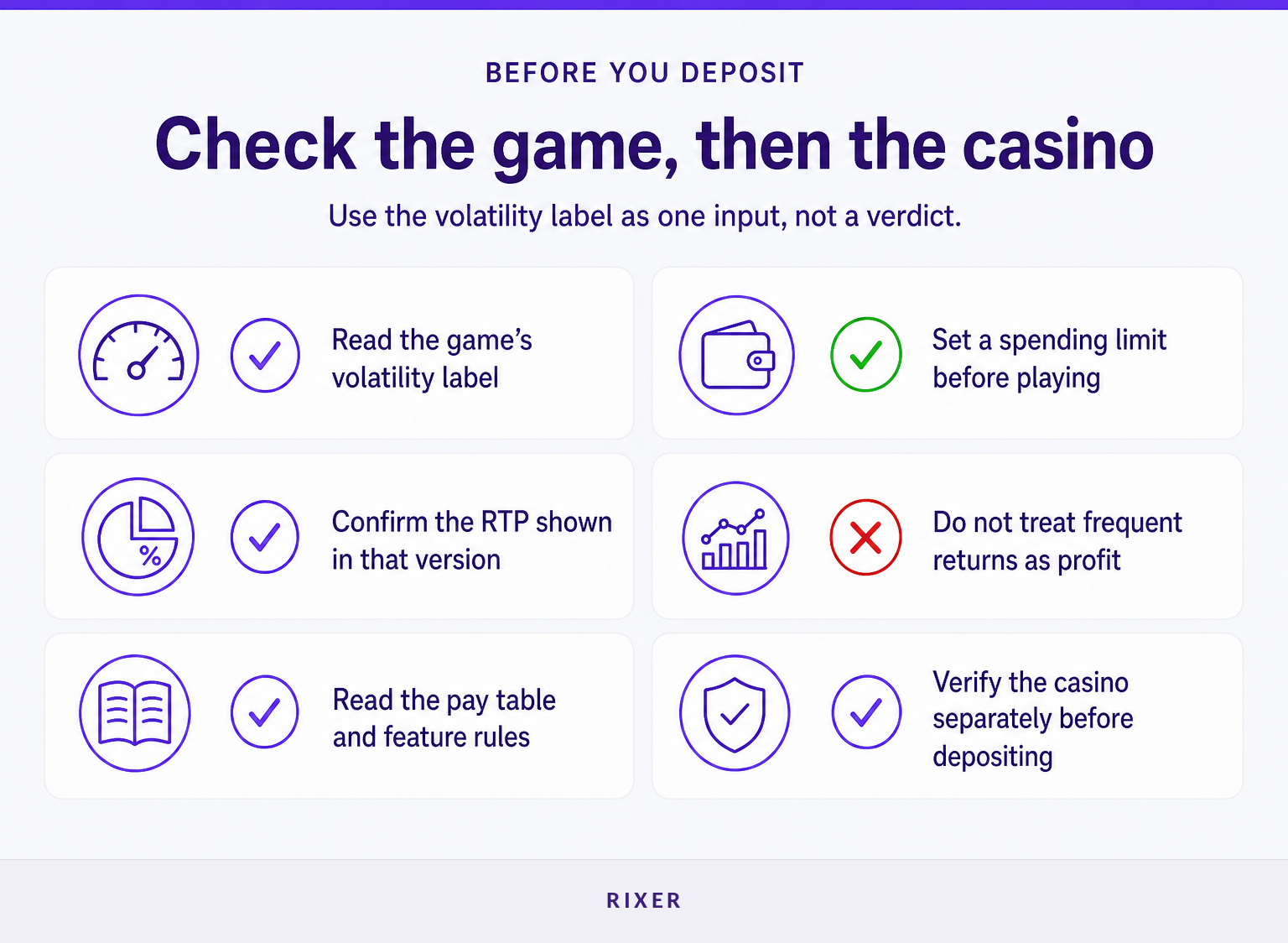
Check the game’s volatility label, its RTP configuration, and the pay table first. Then check the casino that hosts it, because a suitable game does not answer questions about licensing, ownership, country availability, complaints, or withdrawal disputes.
We recommend using this order: confirm the game information, choose a fixed budget, and then compare up to four casino profiles on the same recorded factors before you deposit. If the casino evidence is unclear, the low-volatility label is not a reason to overlook it.
The one thing worth remembering is simple: volatility can describe the experience of playing a slot, but it cannot verify the place asking you to deposit.
Check a casino before you deposit
The licence, who really owns it, and whether it takes players from your country — with the evidence and the date we looked.