Loosest Online Slots: What RTP Can Tell You and What It Cannot

In short
For adult players, the loosest online slots are not games that know you are due a win. The useful test is whether the exact game version shows a credible theoretical RTP, then whether the casino is licensed, available where you are, and transparent enough to consider before depositing.
Key takeaways
- RTP is a long-run theoretical average, not a forecast for a single session, a day, or an individual player.
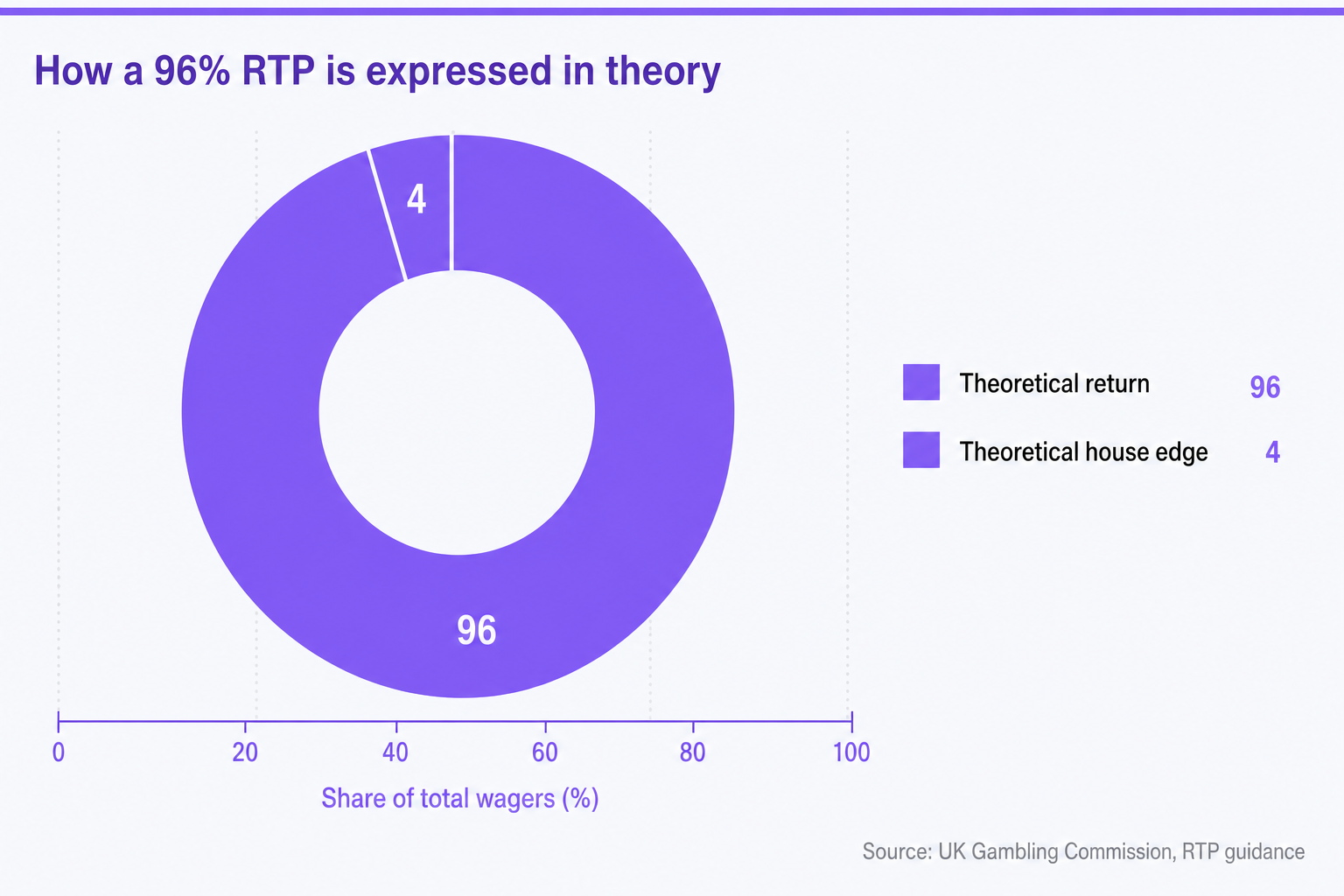
- A slot advertised at 96% RTP theoretically returns $96 for every $100 wagered across an extremely large volume of play, leaving a 4% theoretical house edge.
- A higher RTP does not mean a slot pays more often, because volatility changes the pattern and size of wins.
- A casino's trust record, operator details, license claim, and country availability are separate checks from a game's RTP.
Contents
- What does “loose” mean when people talk about online slots?
- What can RTP tell you about a slot game?
- How do you verify a high-RTP slot claim?
- Can an online casino make a slot looser after you lose?
- What should you compare before depositing?
- Are loose-slots APKs and free-play claims worth trusting?
- What else should you know about loose online slots?
- What should you do next?
What does “loose” mean when people talk about online slots?
When players call a slot “loose,” they usually mean that the game has a relatively high return to player, or RTP. The phrase does not mean that a slot is warming up, remembers recent losses, or is about to pay a particular player.
RTP is a useful starting point because it gives you a number to inspect. It is also an easy number to misuse. A high RTP describes the theoretical return across a very large amount of wagering under the game's rules, not what happens to one bankroll over 20, 100, or 1,000 spins.
That distinction matters because a short session is ruled by random outcomes and volatility. A lower-volatility slot may produce smaller wins more regularly, while a higher-volatility slot can deliver long dry spells and occasional larger wins. Neither pattern makes a game personally “due.”
For UK-licensed remote gambling, the Gambling Commission requires player-facing information about how games work and the likelihood of winning, including house edge, RTP, or the probability of winning events where relevant. The Commission's RTS 3 standard is a useful benchmark for what transparent game information looks like.
The plain-English rule is simple: “loose” is shorthand for long-run game math, not a promise about your next session.
What can RTP tell you about a slot game?
RTP tells you the theoretical share of total wagers that a slot is designed to return over the long run. It cannot tell you when wins will happen, how often they will happen, or whether you will finish a session ahead.
If a game is set to 96% RTP, its theoretical house edge is 4%. Across a huge amount of aggregate wagering, that means a mathematical expectation of $96 returned for every $100 wagered and $4 retained, before considering any separate jackpot mechanics or promotional terms. The Gambling Commission describes RTP as an average measured over a large number of games and notes that normal volatility makes individual sessions vary. Its RTP guidance makes the same point clearly.
Two games can both display 96% RTP and feel completely different. One may return many modest wins. Another may return less often but reserve more of its theoretical value for larger wins, features, or jackpots. RTP measures the long-run percentage, while volatility describes how uneven the journey can be.
RTP is worth checking, but it is only one part of the decision.
How do you verify a high-RTP slot claim?
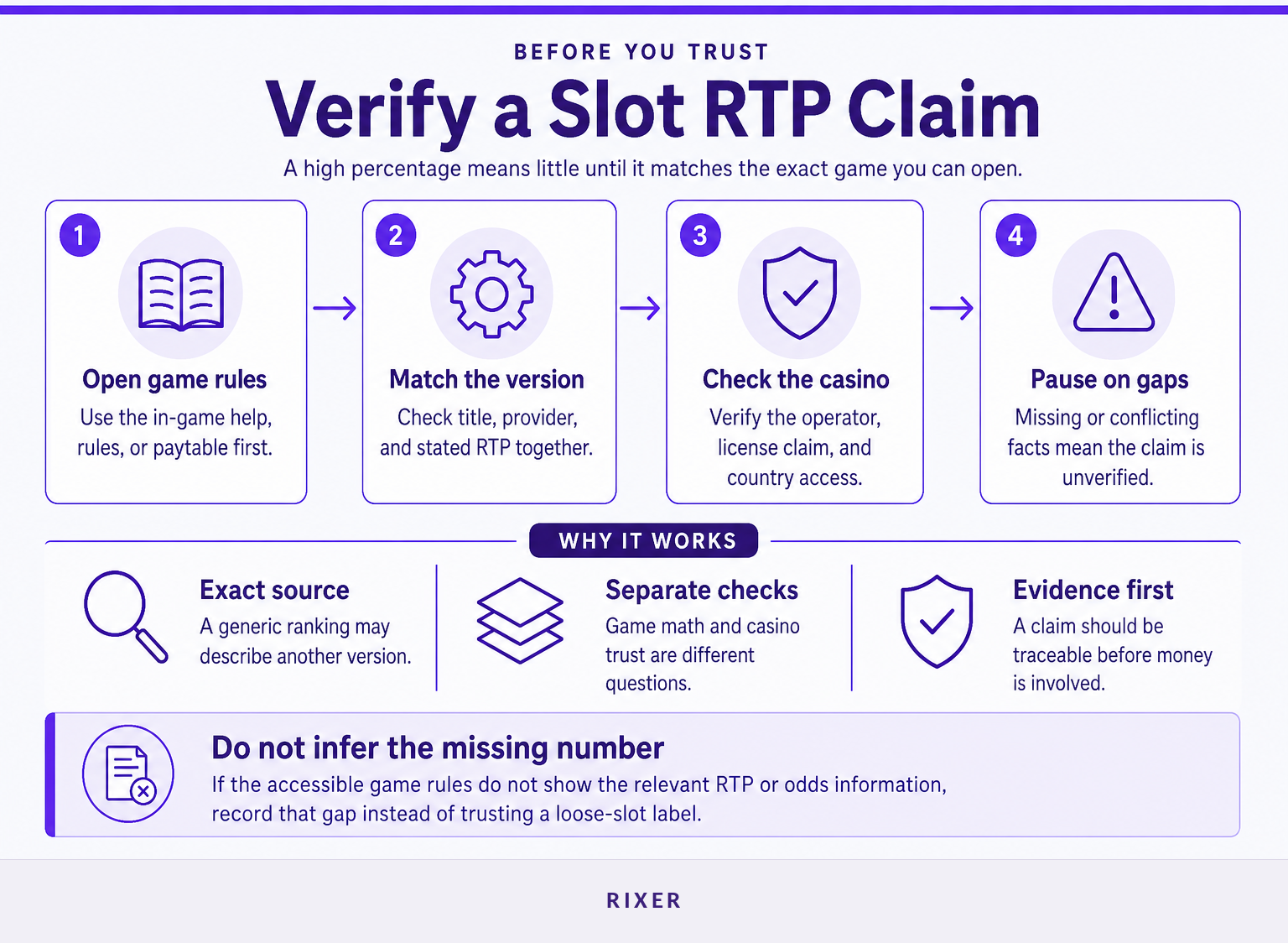
Verify the game inside the casino lobby first, because a search result, listicle, or social post may not describe the exact version you can access. If the game rules do not clearly show the RTP, house edge, or relevant probabilities, treat the claim as unverified rather than filling in the gap with optimism.
Start with the in-game information panel, paytable, or rules screen. Note the exact game title, named provider, stated RTP, and the date you checked it. A provider name can help you investigate the title, but a provider directory is not proof that every casino offers the same game settings. Use Rixer's provider directory as a research starting point, then match what you find against the game in the lobby.
Next, check whether the RTP claim is coming from the game itself, an official provider document, or a third-party ranking. The closer the source is to the exact game version, the better. Under the UK Gambling Commission's testing approach, game rules shown to players should accord with the game's mathematics and help players verify outcomes. The Commission's testing strategy explains that expectation.
Finally, record what you could not confirm. Rixer's evidence-labeling methodology follows the same practical principle: uncertainty is more honest than a neat but unsupported score.
A claim is only as strong as the evidence tied to the exact game version you can actually open.
Can an online casino make a slot looser after you lose?
A reputable regulated operator should not make a slot looser or tighter because of your personal losing or winning history. In the United Kingdom, remote-gambling rules require acceptably random outcomes and prohibit adaptive, or compensated, game behavior.
The UK's RTS 7 rules on random outcomes also say that a game's rules, payouts, and outcome probabilities cannot be changed while it is available for gambling unless the game's rules provide for the change, and material changes must be brought to customers' attention.
That is not the same as saying every casino worldwide operates under the same rules or oversight. It also does not mean a familiar game title always has the same published RTP wherever it appears. The practical response is not to assume manipulation from a losing streak. Check the visible game rules, the casino's regulatory claim, and whether the operator gives you enough information to verify either one.
Game RTP and casino behavior are separate questions. Rixer does not currently score observed withdrawal speed or payment experience because those claims need real player evidence rather than an operator's marketing statement, as explained in our methodology.
A losing run is not proof of a rigged slot, but missing rules and unverifiable operator details are valid reasons to pause.
What should you compare before depositing?

A high RTP slot is not enough reason to trust the casino that hosts it. Before depositing, compare the game's disclosed math with the casino's identity, license information, availability in your country, and public record.
Use this order:
- Game evidence: Can you open the rules and find a stated RTP, house edge, or probability information?
- Exact version: Does the title and named provider match the claim you found, without relying on a generic screenshot or old article?
- Casino identity: Does the casino clearly name its operating company, contact route, terms, and license claim?
- License verification: Can the stated license be checked with the regulator it names, rather than only through a logo in a footer?
- Country availability: Is the casino actually intended to accept players where you are located?
- Evidence gaps: Are important details missing, vague, or inconsistent across the casino's own pages?
Rixer's casino verification tool is built for this second half of the decision: investigating a casino's stated operator, license context, status, and evidence record. It does not turn RTP into a guarantee, and it should not be used as one.
The game can have favorable theoretical math and still be hosted by a casino that fails basic transparency checks.
Are loose-slots APKs and free-play claims worth trusting?
An APK file or a “loose slots” app label is not evidence of a game's RTP, fairness, or operator legitimacy. Free-play mode can show you a game's layout and features, but it cannot by itself verify the real-money version you would play.
Avoid treating an unofficial download as a shortcut to better odds. It gives you no reliable way to confirm the game provider, configuration, operator, or the handling of your personal data. If a casino or app cannot show clear game rules and operator information in the first place, an RTP claim should not rescue it.
The UK Gambling Commission's testing strategy explicitly treats a mismatch between play-for-free and corresponding real-money game rules as a fairness risk to examine. That is a useful standard for players everywhere: demo play may be useful for learning, but it is not proof of real-money payout math. Read the testing guidance.
Free play can teach you the interface; it cannot verify that a real-money slot is “loose.”
What else should you know about loose online slots?
The most useful loose-slots questions are about evidence, not predictions. A credible answer identifies the exact game math and the casino that offers it, while an unreliable answer promises that a slot is ready to pay.
Loosest online slots free play
Free-play versions can help you understand a slot's layout, features, and pace, but they cannot prove that a real-money lobby uses the same RTP configuration. For a UK-licensed product, testing guidance specifically treats a mismatch between free-play and real-money rules as a fairness issue to examine. Treat demos as practice, not payout evidence.
Online casinos with highest slot payouts
An online casino cannot be judged by its slot catalog alone. A casino with high-RTP titles still needs clear ownership, a verifiable license claim, country eligibility, accessible rules, and transparent terms. RTP describes the theoretical return of a game, while the casino's conduct determines whether the wider service is sufficiently trustworthy to consider.
Best payout online slots real money
The best payout online slots are not games that guarantee a profit or a winning session. A higher disclosed RTP can mean a lower theoretical house edge over a vast number of spins, but volatility can still produce very different short-term results. Check the exact game's rules before treating any RTP percentage as relevant.
Is loose slots online casino legit
A site calling itself a loose-slots casino is not legitimate merely because it makes that claim. Look for the named operator, a license claim you can verify, visible game rules, country availability, and clear terms. If the site relies on urgency, secret algorithms, or downloadable apps instead of evidence, do not deposit.
The best answer to a loose-slots claim is a trail of evidence that another person can check too.
What should you do next?
Pick one game claim and test it rather than chasing ten rankings. Confirm the RTP in the game information, then compare the casino's operator, license context, availability, and evidence record before considering any deposit.
Use Rixer's casino comparison tool to put up to four casino profiles side by side, then walk away from any option whose key facts cannot be verified. Gambling involves risk, and RTP is never a promise of profit.
The safer decision is the one you can explain from the game rules and the casino record, not from a loose-slot label.
Check a casino before you deposit
The licence, who really owns it, and whether it takes players from your country — with the evidence and the date we looked.