Video Poker Strategy: Why the Pay Table and Game Variant Matter

In short
Video poker strategy starts with the exact game and pay table in front of you. Use a chart that names both, play the credit level its return assumes, and treat the result as a way to reduce mathematical mistakes, not as a promise of profit or a reason to chase losses.
Key takeaways
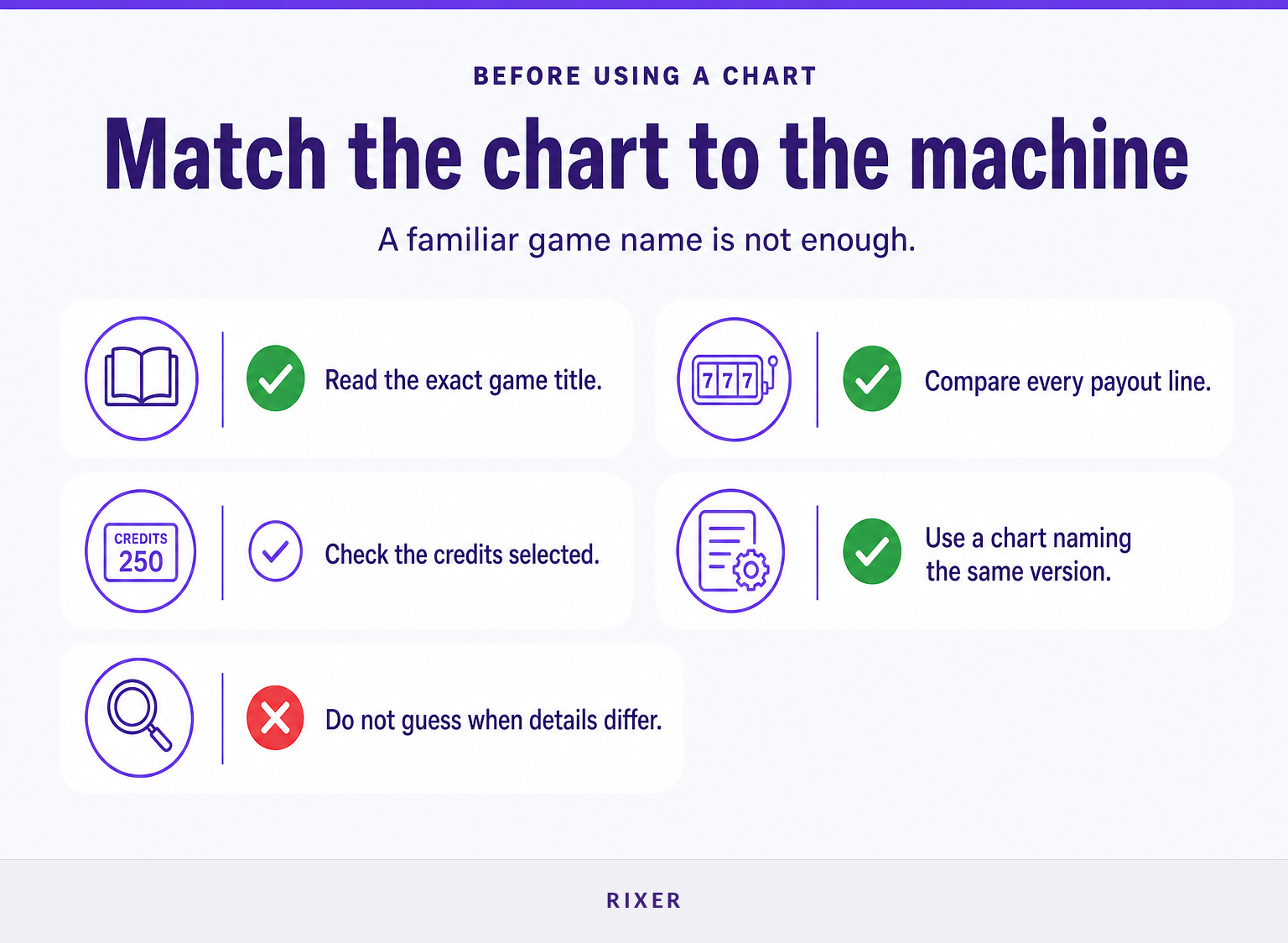
- A full-pay 9/6 Jacks or Better game returns 99.54% in theory only when played with optimal strategy and the five-credit assumption used in the published table. (wizardofodds.com)
- A 9/5 Jacks or Better pay table has a 98.45% optimal return in the same 2026 summary, showing why one changed payout line matters. (wizardofodds.com)
- A Deuces Wild chart is not a Jacks or Better chart with wild cards added, because the wild cards and payout hierarchy change which holds have the highest value. (wizardofodds.com)
- Correct strategy can reduce avoidable errors, but it cannot make a negative-expectation game a reliable source of profit.
- A mathematically sound chart does not verify the casino offering the game, so check the operator, license claims, country availability, and public record separately.
On this page
- What is the correct video poker strategy?
- Why does the pay table change your strategy?
- How do you choose the right strategy chart?
- Is video poker winnable?
- What should you check before playing video poker online?
- What else do players ask about video poker strategy?
What is the correct video poker strategy?
The correct video poker strategy is the decision order calculated for one named game, one exact pay table, and usually one stated betting level. A generic chart can be worse than no chart if it makes a player confidently use advice that belongs to a different machine.
Video poker starts with five cards. The player chooses which cards to hold, discards the rest, and receives replacements. The difficult part is that several holds can look reasonable at once: keep a made pair, chase four cards to a flush, keep high cards, or hold a partial straight.
Strategy solves those conflicts by ranking the available holds according to their long-run expected value. It is not a prediction that the next draw will win. It is a mathematical answer to a narrower question: which choice loses the least value, or gains the most value, over a very large number of identical hands?
That is why the title at the top of a chart matters as much as the chart itself. Before using one, match these four details:
- Game family: Jacks or Better, Bonus Poker, Deuces Wild, Double Double Bonus, Ultimate X, or another named format.
- Exact pay table: The payout numbers for each made hand, not just the game title.
- Credits played: Many published returns assume five credits because the royal-flush payout changes at maximum credits.
- Chart version: A simplified chart and a fully optimal chart can have different quoted returns.
For example, the August 2026 full-pay 9/6 Jacks or Better strategy table lists a 99.54% theoretical return with optimal play. The same source says its simpler and intermediate versions return 99.46% and 99.52%, respectively. (wizardofodds.com)
The useful lesson is not that every player needs to memorize an exception-heavy chart. The useful lesson is that every player needs a chart that actually matches the game.
A video poker strategy chart is only useful when its game name, pay table, and credit assumption match the screen in front of you.
Why does the pay table change your strategy?
The pay table is the scorecard, not decoration. When payouts change, the value of competing holds can change too, which is why a chart for one version should not be silently carried to another.
In Jacks or Better, the familiar label 9/6 refers to a full house paying 9 credits and a flush paying 6 credits per coin at the stated maximum-credit assumption. The 2026 summary table shows a 99.54% return for 9/6 Jacks or Better, while a 9/5 version is listed at 98.45% with optimal play. (wizardofodds.com)
A lower return does not mean every decision in the chart suddenly changes. It means the mathematics behind the decisions has changed, and some close choices may now rank differently. That is enough to make an unmatched strategy chart unreliable.
The gap becomes more obvious across variants. In 20/12/9/5/3/2 Deuces Wild, deuces are wild and the pay table includes hands such as four deuces, wild royal flushes, and five of a kind. The linked strategy table reports a 98.9378% optimal return for that exact version, not a universal Deuces Wild figure. (wizardofodds.com)
This is also why a game with multipliers, extra hands, bonus events, or special features needs its own chart. The base hand may look like ordinary poker, but the feature can alter the value of a draw.
The shortest rule is also the safest: if a chart does not repeat the game title and the pay table you can see, do not assume it applies.
A one-line payout difference can affect the game’s long-run return and the best choice in close hands.
How do you choose the right strategy chart?
Choose a strategy chart only after you have identified the game variant, read the whole pay table, and checked the credit assumption. This order prevents the most expensive strategy mistake: learning the right moves for the wrong game.
Start with the game screen rather than a search result. A search for a video poker strategy PDF may surface a useful chart, but the machine or online game must be the thing that determines which chart you need.
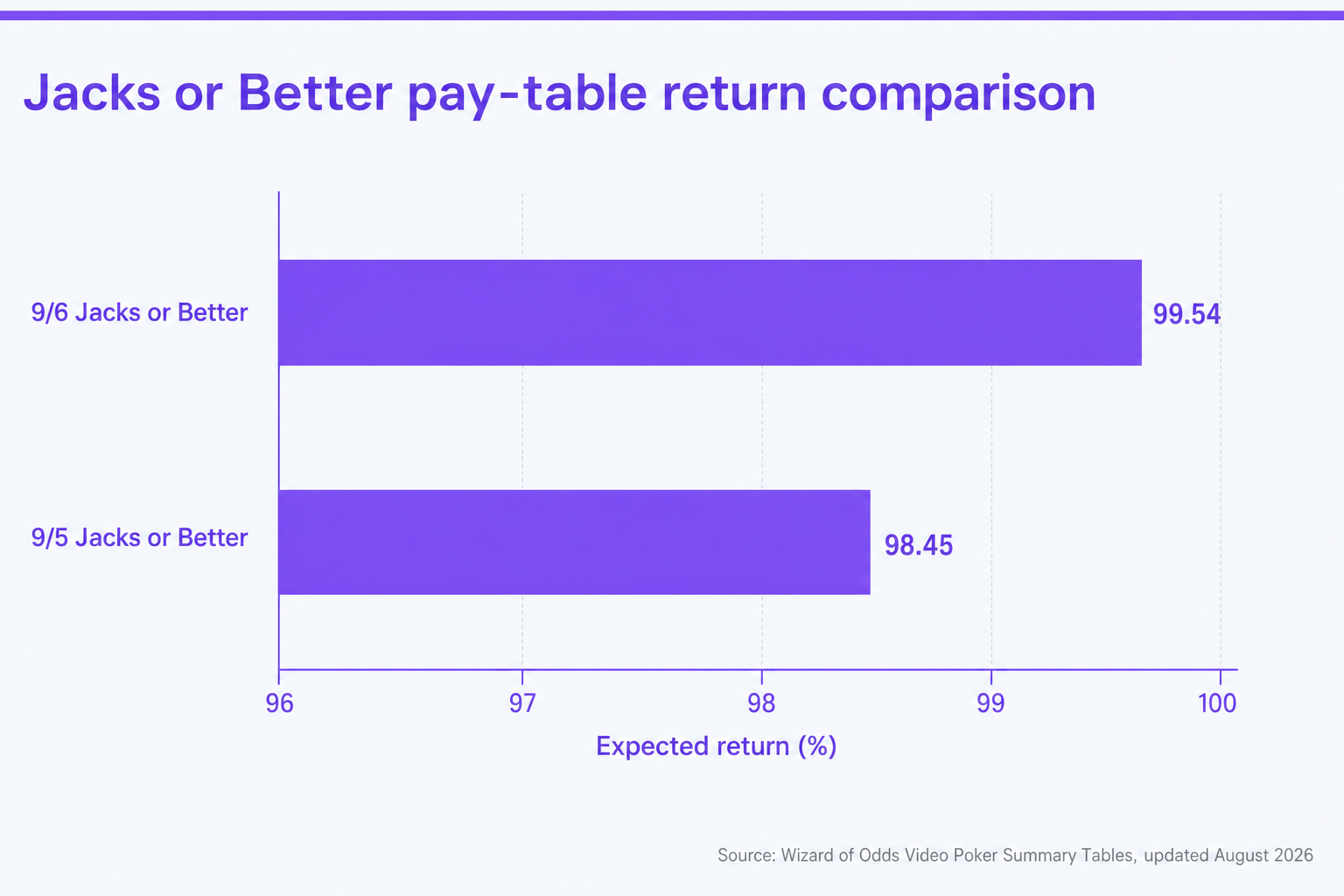
Use this five-step check:
- Read the game title exactly. Do not stop at the word poker. Note every modifier, including wild cards, bonus payouts, multipliers, or multi-hand play.
- Record the payouts. Compare every listed hand, especially full house, flush, quads, and special hands.
- Check the credits. If the chart assumes five credits, do not treat its return as your return when playing fewer.
- Find a chart that repeats the same details. The chart should name the variant and pay table, not merely a broad game family.
- Use the chart as a priority list. When more than one hold looks attractive, use the highest applicable line rather than trusting the apparent strength of the current hand.
For readers trying to identify who made a particular game or which variants appear across a catalog, our game-provider directory can be a useful research starting point. It does not replace checking the actual game screen and pay table.
A good strategy chart matches the game first, then tells you what to hold.
Is video poker winnable?
A video poker hand can certainly win, and a short session can finish ahead. Video poker is not reliably winnable in the sense of a strategy guaranteeing long-term profit, because expected return describes an average over many hands, not a promise for one person or one session.
A 99.54% expected return for full-pay 9/6 Jacks or Better corresponds to a theoretical house edge of about 0.46% under the stated optimal-play assumptions. That is comparatively low for a casino game, but it is still below 100%, and normal variance can produce sharply different short-run results. (wizardofodds.com)
The mistake to avoid is treating a strong theoretical return as a safety net. It is not. A royal flush is rare, bankroll swings are real, and moving to a lower pay table, using a mismatched chart, or playing fewer credits can reduce the quoted return.
Use a fixed entertainment budget before starting. If the budget is gone, the strategy has done its job only if it helps you stop rather than chase a result.
Optimal strategy improves decisions over time; it does not remove variance or create guaranteed profit.
What should you check before playing video poker online?
Video poker strategy and casino verification solve different problems. A perfect chart can help with a hold decision, but it cannot confirm who operates the site, whether it accepts players where you live, or whether public complaints raise concerns.
Before depositing, check the game and the casino as separate layers:
- Game layer: Confirm the variant, pay table, credits selected, and strategy chart.
- Casino layer: Check the brand status, stated operator, stated licensing authority, country availability, and public player record.
- Evidence layer: Prefer records that show what was checked and when, rather than relying on an unexplained safety label.
- Personal layer: Confirm that gambling is legal for you, set a firm spend limit, and do not use gambling to solve a money problem.
At Rixer, the casino verification lookup is designed to help adult players investigate a casino’s public record before depositing. The Rixer Trust Score methodology explains how evidence labels, unknown information, and documented factors are handled.
If you are choosing between more than one operator, use our casino comparison tool before you commit money. Compare the records first, then decide whether the game itself has a pay table and strategy chart you are comfortable with.
The right video poker decision has two parts: use the chart that fits the game, then verify the casino offering it.
What else do players ask about video poker strategy?
The same questions recur because strategy, winnings, and budgeting are often confused with one another. The direct answers below separate what the math can tell you from what it cannot promise.
What is the best strategy for winning in video poker?
The best video poker strategy is to use the highest-accuracy chart that matches the exact game, pay table, and credit level being played. For full-pay 9/6 Jacks or Better, optimal strategy is associated with a 99.54% theoretical return, but that return is not a guarantee of a winning session. (wizardofodds.com)
What is the $20 method at the casino?
The $20 method is not a universal video poker strategy or a mathematical route to profit. It is usually a personal spending rule: decide that $20 is the full entertainment budget, choose a stake that makes that budget last, and stop when the limit is reached without increasing the stake to recover losses.
Is video poker winnable?
Video poker is winnable on individual hands and in some individual sessions, but no standard strategy guarantees that a player will finish ahead. A correct chart improves the long-run value of decisions for a specific game; it does not overcome a house edge, variance, a lower pay table, or poor bankroll discipline.
The number worth remembering is not the size of a possible payout. It is whether your strategy chart matches every relevant detail on the game screen.
What should you do before your next hand?
Read the title. Read the pay table. Check the credits. Then use a chart written for that exact combination.
If any of those details do not match, pause before pressing Deal. The familiar chart is not necessarily the correct one.
Check a casino before you deposit
The licence, who really owns it, and whether it takes players from your country — with the evidence and the date we looked.