Online Roulette: How to Check the Casino, Game Provider, and Rules Before Playing


In short
Online roulette is not something to judge from a glossy lobby or a large welcome offer. Before depositing, adult players should verify that the casino is permitted to serve their location, identify the operator and game provider, read the exact roulette rules, and look for dated evidence of complaints or regulatory action.
Key takeaways
- A roulette game can be legitimate only in the context of a casino that is authorized to serve your location and can be matched to a real legal business.
- A single-zero wheel has 37 pockets and a standard house edge of about 2.70%, while a double-zero wheel has 38 pockets and a standard house edge of about 5.26%.
- RNG roulette and live-dealer roulette need different checks: RNG games need rules and testing context, while live tables also need an identifiable studio and game procedures.
- A provider name, clear rules, published game information, and a consistent casino identity are stronger signals than marketing language or a licence badge alone.
- Complaint records are context, not a verdict: look for repeated issues, dates, operator responses, and whether the casino's explanation matches its terms.
Table of contents
- What should you check before choosing an online roulette game?
- Is the casino allowed to serve players where you are?
- Who made the roulette game, and can you identify it?
- Which roulette rules change the math?
- How can you assess RNG and live-dealer roulette?
- What do complaints and terms reveal before you deposit?
- What are the most common online roulette questions?
- What is the sensible next step?
Online roulette comes in many forms: browser-based RNG games, mobile games, live-streamed tables, single-zero wheels, double-zero wheels, and formats with extra features. That variety makes it tempting to compare only the game menu. The safer order is to check the business first, then the game.
This guide is for adults. Online gambling laws, minimum ages, product availability, and player protections differ by country, state, province, and territory. A casino appearing in a search result does not establish that it can legally accept you.
What should you check before choosing an online roulette game?
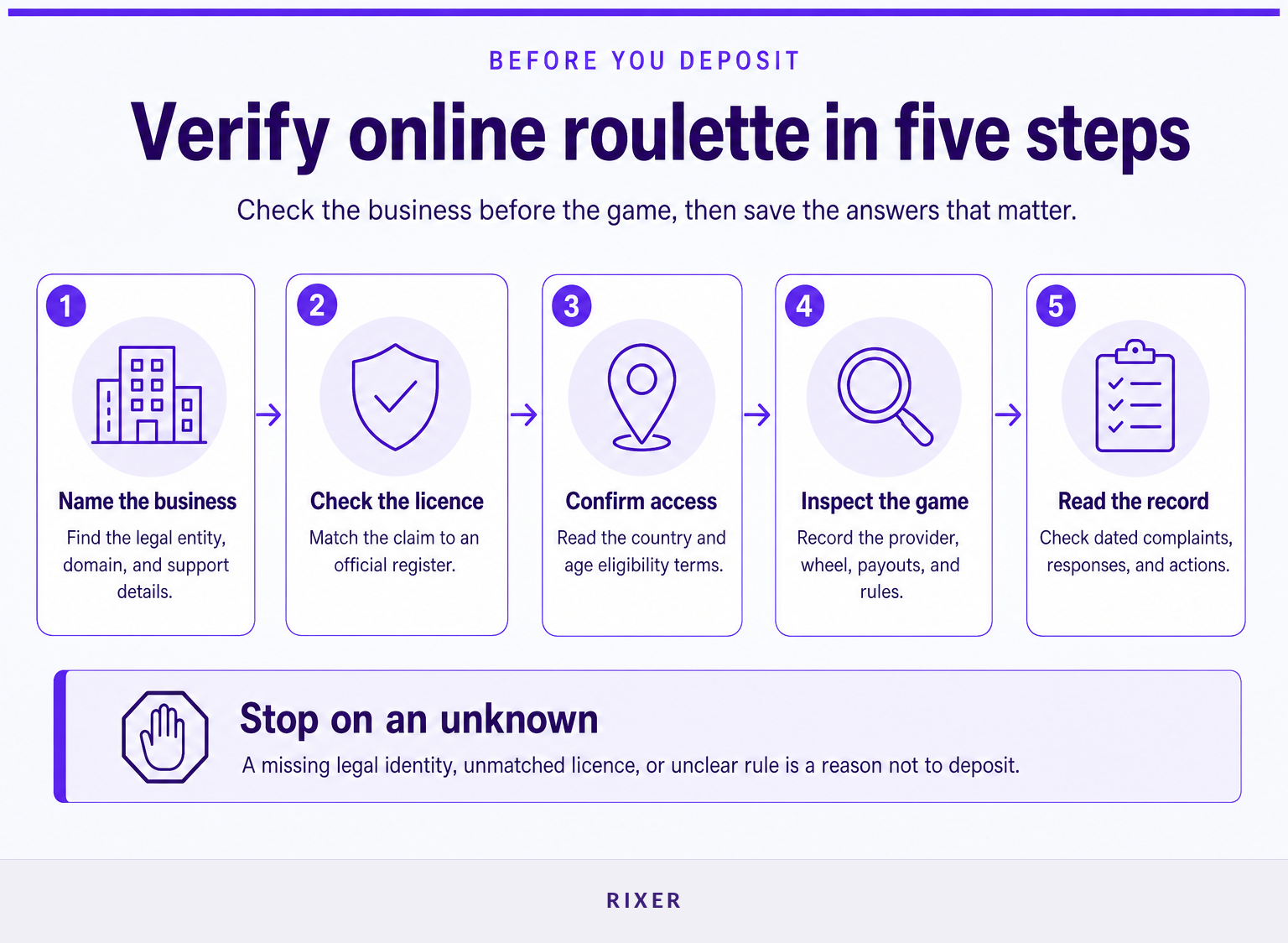
Start with the casino's identity and legal status, not the roulette thumbnail. Then check the named game provider, the exact wheel rules, the country restrictions, and the casino's public record before treating a game as a serious option.
A practical check takes minutes, and it should produce answers you can save:
- Name the business. Find the casino's legal entity, trading name, website domain, and support contact details. A brand name alone is not enough.
- Check its claimed authority. Use the regulator's public register, rather than trusting an image in the footer. For example, the UK Gambling Commission says players can check the business name, domain, trading name, licence status, and regulatory action through its public register. Rixer's licence directory can help put claimed licences in context, but the regulator's record remains the primary source.
- Confirm country access. Read the casino's eligibility terms and check that the selected country in any comparison tool is your player location, not the location where the casino says it is licensed.
- Identify the game. Open the roulette game's information or rules panel and note the provider, wheel variant, payouts, special rules, and version name.
- Read the evidence trail. Look for dated public complaints, recurring themes, the casino's replies, and any record of regulatory action. One complaint is not proof. A pattern that conflicts with the terms deserves attention.
The UK Gambling Commission's public guidance specifically recommends matching a gambling website's domain and licence details to its public register before transferring money. Its business register was updated on November 2, 2026, but that register applies to Great Britain, not every market. Other regulators have their own registers. (gamblingcommission.gov.uk)
The first useful roulette decision is not a bet selection. It is deciding whether the casino and game can be independently identified.
Is the casino allowed to serve players where you are?
A casino's licence, its player-country availability, and your physical location are separate facts. Check all three before registering or depositing, because a familiar brand can operate under different rules, entities, or domains in different places.
Begin with the casino footer and terms. Look for the legal company name, jurisdiction, licence number where applicable, and a list of restricted countries or territories. Then search the relevant regulator's database using the legal entity and domain, not only the casino's logo.
For Great Britain, the UK Gambling Commission's register lets users search by business name, trading name, and domain name, and it displays licence status and regulatory actions. The Malta Gaming Authority's Licensee Register also supports searches by licensee name, authorization status, URL, or gaming service. A licence badge that cannot be matched to an official entry is an unresolved claim, not a green light. (gamblingcommission.gov.uk)
Do not use a VPN or location workaround to bypass a casino's stated restrictions. That can create account-verification, withdrawal, and terms-of-service problems. If you are traveling, you may also want to check your connection usage before opening a casino site or app. This guide to checking iPhone data usage while traveling explains the device-side steps without making any claim about gambling access.
Country eligibility is a precondition, not a minor checkbox: if the casino cannot clearly establish that it accepts players where you are, stop before depositing.
Who made the roulette game, and can you identify it?
The casino operates the account, but the roulette game may be supplied by a separate studio or software provider. A credible game should have an identifiable provider, a stable title, and accessible rules that match the version shown in the lobby.
Open the game before playing and look for its information panel, help icon, or rules link. Record the game title exactly. Then check these details:
- Provider or studio name: It should be shown consistently in the lobby, game information, and rules.
- Game mode: Identify whether it is RNG roulette, live-dealer roulette, or a variant with additional features.
- Wheel format: Look for single zero, double zero, triple zero, or another layout. Do not infer the format from the table's visual design.
- Payout table and special rules: The game rules should explain how inside bets, outside bets, zero outcomes, and any special mechanics work.
- Version consistency: A similarly named game can have different rules across markets or product versions.
Use a game provider check to connect the provider name to the casinos where it appears, then return to the game's own rules. The provider check helps answer who made the game; it does not replace reading its current rule page.
This is also why a roulette game should not be judged solely by a stated RTP figure. Roulette's baseline mathematics is largely visible in the wheel layout and payout rules, while a game variant can add mechanics that change what the player is actually being offered.
A roulette game's provider name matters because it gives you a concrete identity to verify, not because a provider label guarantees a particular experience.
Which roulette rules change the math?
The wheel layout changes roulette's mathematical baseline before a spin starts. For standard payouts, a single-zero wheel has a lower house edge than a double-zero wheel because the extra zero adds another losing outcome for most bets.
New Jersey's roulette regulations describe single-zero wheels with 37 compartments and double-zero wheels with 38 compartments. The UK Gambling Commission also uses 35-to-1 as the example payout for a single-number roulette wager. Those two facts produce the standard house-edge calculations below: 1 divided by 37, or about 2.70%, for a single-zero wheel; and 2 divided by 38, or about 5.26%, for a double-zero wheel. (nj.gov)
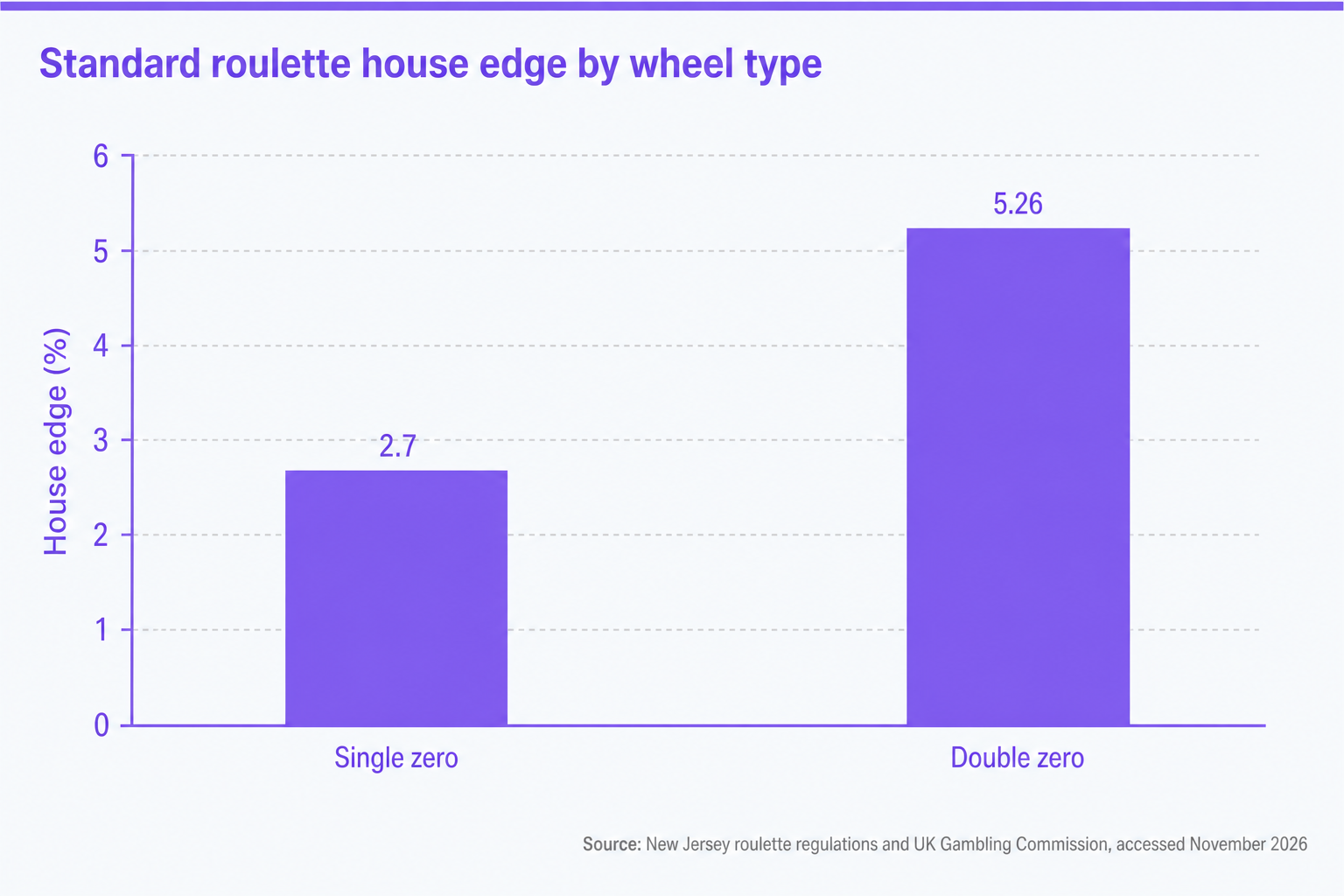
| Wheel type | Pockets | Standard house edge | What to check in the rules |
|---|---|---|---|
| Single zero | 37 | 2.70% | One green zero, standard payouts, and any special zero rule |
| Double zero | 38 | 5.26% | Both 0 and 00, plus any additional side bets or features |
The table does not predict what will happen in a session. A house edge is a long-run mathematical measure, not a forecast for the next spin or the next 100 spins. The UK Gambling Commission makes the same distinction when explaining RTP: an average percentage is not what a player should expect from a single session. (gamblingcommission.gov.uk)
The clearest rules check is simple: count the zero pockets, read the payout table, and do not treat a short run of outcomes as evidence that the game has changed.
How can you assess RNG and live-dealer roulette?

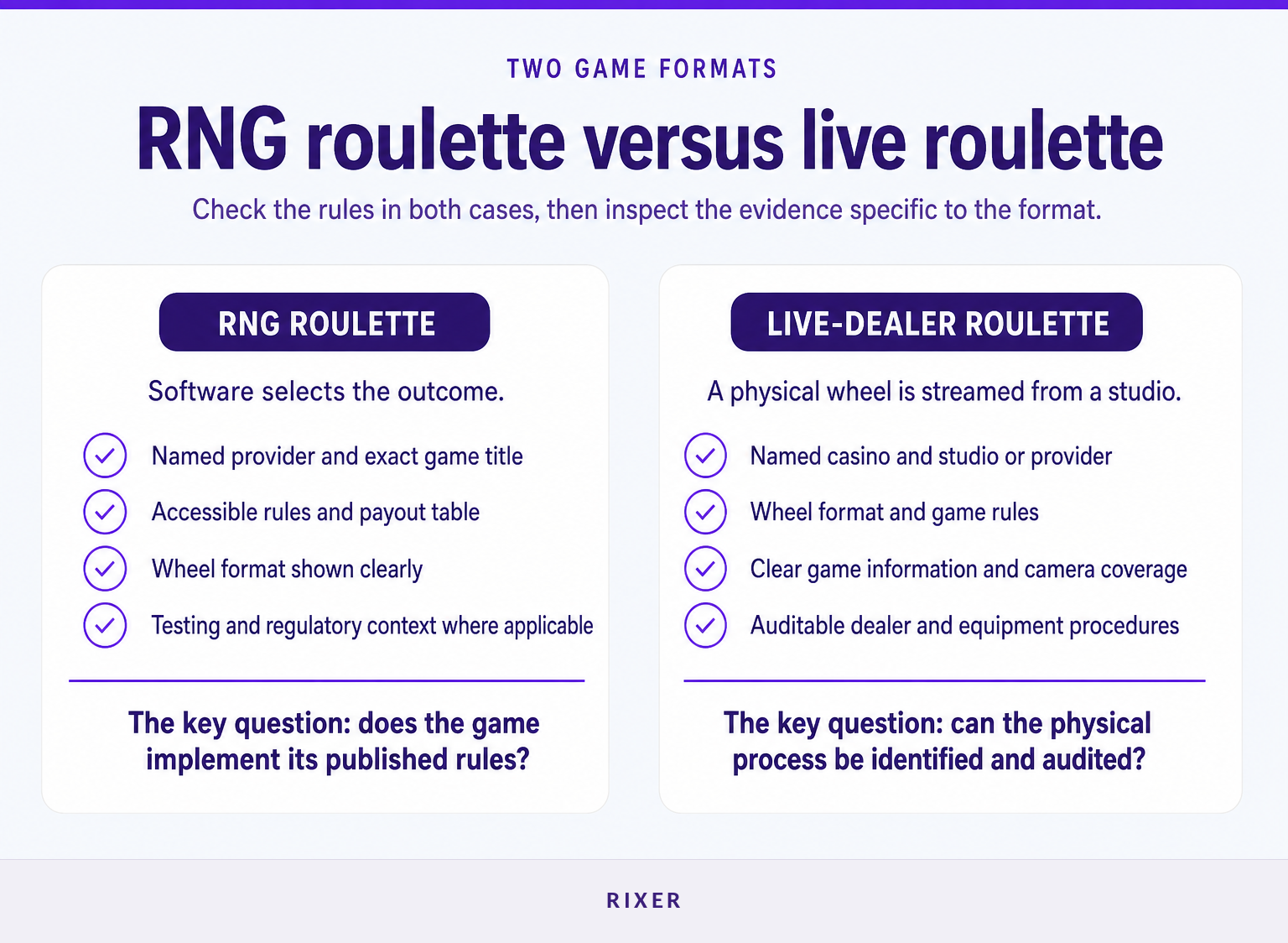
RNG roulette and live-dealer roulette can both be fair, but the evidence you should look for is different. RNG games rely on software-generated outcomes, while live games add a physical wheel, dealer procedures, video feed, and studio controls.
For RNG roulette, check that the game rules are available before a wager, the provider is named, and the game version can be identified. In Great Britain, the Gambling Commission's remote technical standards require random outcomes to be acceptably random and require games to follow the rules and probabilities disclosed to customers. Licensed remote casino operators must also submit game and RNG test results under that regulatory system. (gamblingcommission.gov.uk)
For live-dealer roulette, inspect the camera view and game information as well as the operator and studio identity. The UK Gambling Commission's live-dealer standard says operations should be fair and independently auditable, with recorded dealer activity, protected equipment, documented procedures, and game logs. That is an example of a regulator's expectations, not proof that every live table worldwide meets the same standard. (gamblingcommission.gov.uk)
For either format, do not confuse a familiar interface with evidence. A casino verification record is most useful when it distinguishes what has been confirmed, what the casino claims, and what cannot yet be verified.
Fairness is not established by a spinning wheel animation or a live video feed; it is established by identifiable parties, accessible rules, and evidence that matches the product in front of you.
What do complaints and terms reveal before you deposit?
Complaints and terms can reveal operational risks that roulette rules cannot, including identity checks, account restrictions, withdrawal disputes, or slow support. They are useful only when you read them as dated evidence with context, not as a scoreboard of angry comments.
Look for these patterns:
- Repeated issue, not isolated outrage: Several recent complaints describing the same problem deserve more scrutiny than one vague post.
- Timeline: Note when the player deposited, when the issue began, what documents were requested, and whether the casino responded.
- Terms match: Compare the casino's response with its published verification, bonus, account, and withdrawal terms.
- Brand versus operator: A complaint may concern an operating company that runs multiple brands. Knowing the legal operator helps you see the wider picture.
- Resolution quality: A response is not automatically a resolution. Look for a specific outcome, supporting evidence, and a clear explanation.
No review platform can prove that a casino will pay a future withdrawal, and Rixer does not claim to offer observed withdrawal-speed scoring. The more realistic question is whether the brand can be identified, its claims are evidenced, and its public history gives you unresolved reasons to pause.
Before you deposit, use Rixer's casino comparison tool to place up to four casino records beside each other and compare the available licence context, operator information, country availability, complaint record, status, and evidence dates. If a key answer is missing, do not fill the gap with optimism.
The terms tell you what the casino says it will do; complaint records help you test where that promise has been challenged in public.
What are the most common online roulette questions?
Online roulette questions often sound like strategy questions, but the first answers are usually about the wheel format, the game's rules, and the casino's verifiable status. The four questions below address the exact issues players commonly raise before choosing a roulette game.
What's the best online roulette?
The best online roulette is not a universal title or casino brand. For an adult player, the stronger option is a game at a casino that is authorized to accept that player's location, identifies its operator and provider, publishes accessible rules, and clearly states the wheel format. A standard single-zero game has a lower house edge than a standard double-zero game.
Can I win on roulette?
A player can win individual roulette spins, but no roulette system can remove the house edge built into the wheel and payouts. A standard single-zero wheel has about a 2.70% house edge, while a standard double-zero wheel has about a 5.26% house edge. Short-term results do not change those underlying probabilities.
Is roulette luck or skill?
Roulette outcomes are chance-based, so skill does not let a player predict a fair next spin. Player judgment still matters before play: choosing a lower-edge wheel format, understanding the rules, setting a limit, and verifying the casino can reduce avoidable decision errors. Those checks do not turn roulette into a beatable game.
What is statistically the best bet on roulette?
For standard roulette bets on the same wheel, the expected house edge is generally determined by the wheel's zero pockets and payout structure rather than a betting pattern. The bigger statistical choice is usually a single-zero wheel over a double-zero wheel. Read the specific rules because special bets or variant features can have different payouts and terms.
The most useful roulette statistic is the wheel's house edge, because it tells you more about the long-run trade-off than a claim that one pattern can predict the next result.
What is the sensible next step?
Do not start by asking which roulette game looks most exciting. Start by asking who runs the casino, who made the game, which rules apply, and which official or dated records support those answers. If the casino cannot be verified or the game rules are unclear, the sensible move is to leave it unopened and keep your money.
Check a casino before you deposit
The licence, who really owns it, and whether it takes players from your country — with the evidence and the date we looked.