Matchbook.com Review: Licence, Operator, Commission, and Player Evidence


In short
Matchbook is a peer-to-peer betting exchange operated by Triplebet Limited. As checked on November 20, 2026, the UK Gambling Commission lists Triplebet as active, lists Matchbook as a trading name, and lists www.matchbook.com as an active domain, which supports legitimacy but does not remove betting, liquidity, or account-level risk.
- The UK Gambling Commission's Triplebet record shows active remote licences as of November 20, 2026, including betting intermediary, pool betting, casino, and remote general betting activities.
- The Commission's domain-name record lists www.matchbook.com as active under Triplebet Limited, account number 39504.
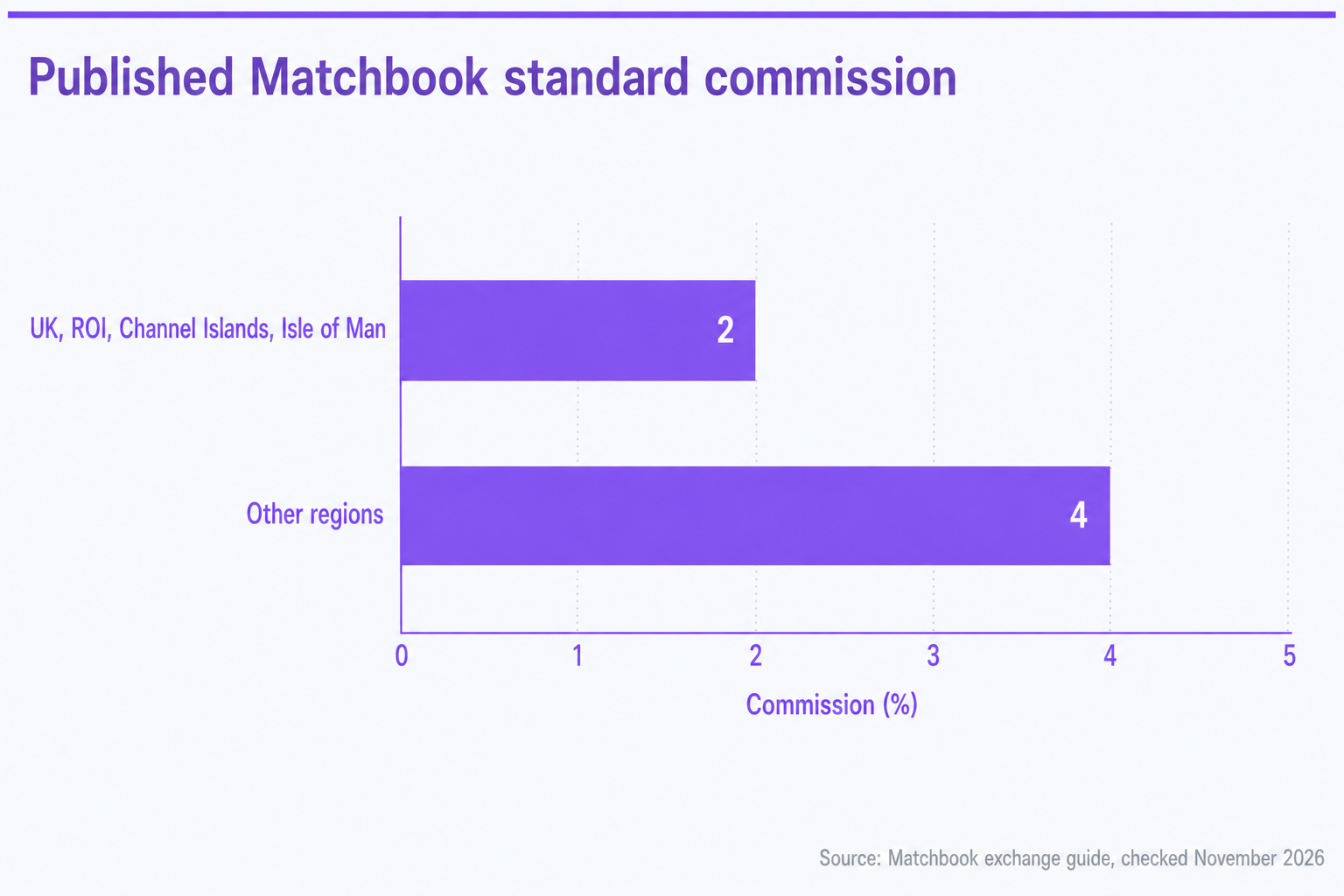
- Matchbook's published exchange guide says standard commission is 2% of net market profit for customers in the UK, Republic of Ireland, Channel Islands, and Isle of Man, and 4% for customers elsewhere.
- A betting exchange can leave an offer unmatched or only partly matched, so quoted odds are not the same thing as a guaranteed bet placement.
- App ratings can indicate how users feel about the mobile product, but they cannot independently prove withdrawal outcomes, dispute handling, or account suitability.
Contents
- What is Matchbook and how does exchange betting work?
- Is Matchbook safe?
- Who operates Matchbook and what licence can you verify?
- What is the Matchbook commission rate?
- What can go wrong on a betting exchange?
- How should you read Matchbook player feedback?
- Frequently asked questions about Matchbook
- What should you check before you risk money?
A Matchbook review needs a different starting point from a standard sportsbook review. The central question is not only whether the site has markets you like. It is whether you understand who runs the exchange, which facts can be verified independently, how commission is charged, and what happens when another customer does not take the other side of your bet.
What is Matchbook and how does exchange betting work?
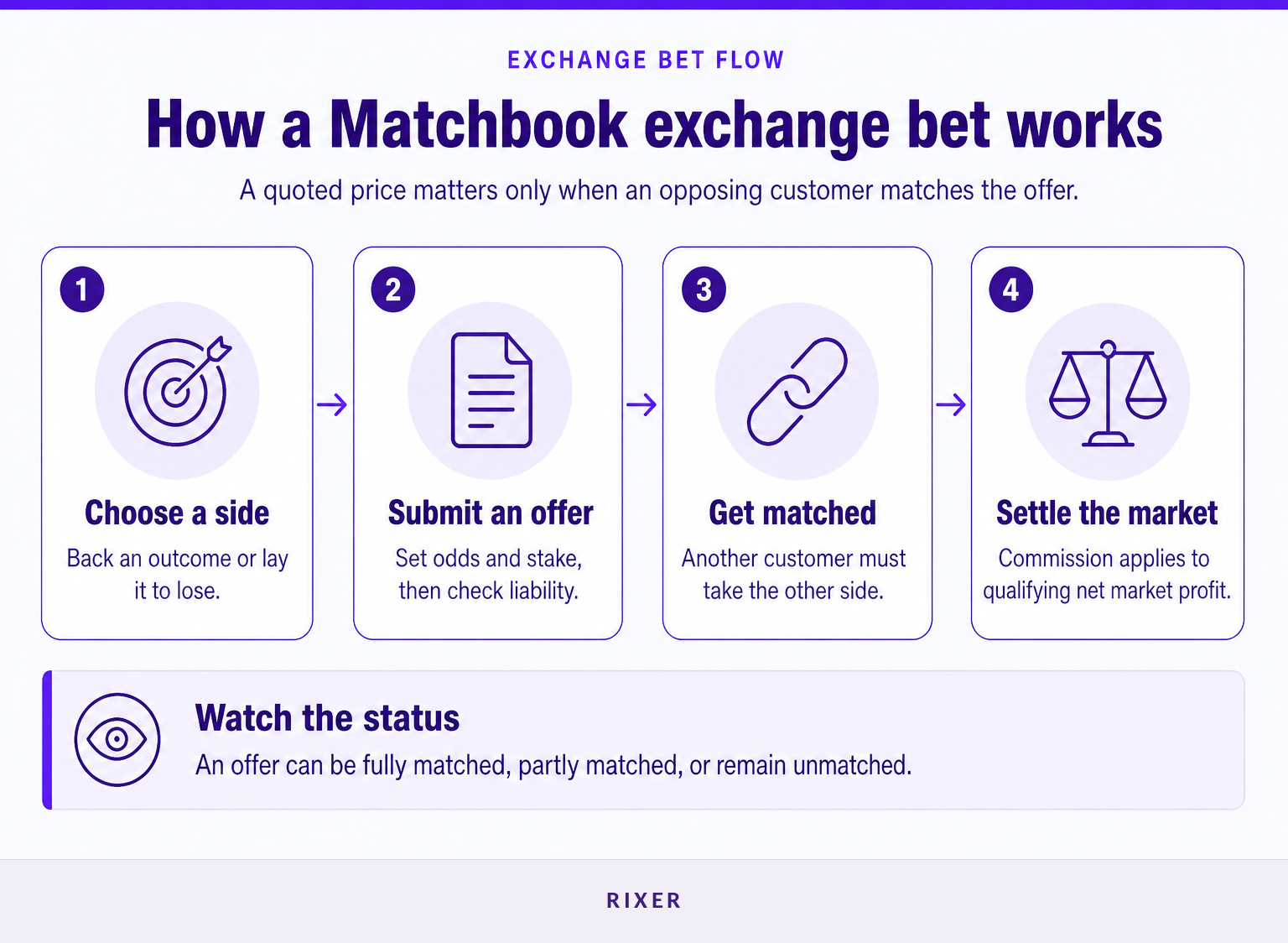
Matchbook is primarily a peer-to-peer betting exchange: customers can back an outcome or lay an outcome, while the platform matches opposing offers. Instead of a bookmaker setting every price and taking the other side, Matchbook facilitates a market between anonymous customers and charges commission on qualifying net profit.
A back bet is the familiar side of betting. You are backing a team, horse, player, or outcome to happen. A lay bet is the other side: you are taking on liability if that selection wins, much like acting as the layer rather than the backer.
The important word is matched. You can submit an offer at your chosen odds, but another customer must accept it. If liquidity is thin, all or part of an offer can remain unmatched. Matchbook's market rules say that partially matched offers are displayed so the customer can manage or cancel the unmatched portion.
That changes the decision you make before placing a bet. A price can look appealing and still be unusable if there is no counterparty, if the available stake is too small, or if the market moves before your order matches. In-play betting adds another layer because an offer can be held during a time delay before reaching the market.
The practical point is simple: on an exchange, odds, available stake, liability, and matching status matter together. An attractive number alone is not the whole offer.
Is Matchbook safe?
Matchbook has independently verifiable UK regulatory and identity signals, which is a meaningful positive sign. Safety is still not a promise that every bet will be matched, every account experience will be smooth, or gambling will be financially safe for an individual.
The strongest current check is the UK Gambling Commission licence summary for Triplebet Limited. On November 20, 2026, that public record showed five active remote gambling activities under account number 39504, including Betting Intermediary Remote, Pool Betting Remote, Casino Remote, and remote general betting licences.
The same regulator's records make the brand-to-company connection less fuzzy. Its trading-names page lists Matchbook as an active trading name of Triplebet Limited, while its domain record lists www.matchbook.com as active. That is more useful than relying on a licence badge copied into a website footer.
There is relevant historical context too. The Gambling Commission announced a licence review and immediate suspension affecting Triplebet Limited on February 18, 2020. The current register now shows active licences, so the 2020 notice should not be presented as the operator's current status. It is still part of the public record and worth reading alongside the present-day licence summary. Read the Commission's 2020 notice.
Regulation is one layer, not the entire decision. It does not tell you whether a specific market has enough liquidity, whether a particular payment method fits your situation, or whether betting is affordable for you. It also does not make an exchange risk-free.
A current licence record can verify who is authorized to operate, but it cannot make a betting decision safe on your behalf.
Who operates Matchbook and what licence can you verify?
The operator that can be independently verified in Great Britain is Triplebet Limited, UK Gambling Commission account number 39504. The Commission lists Matchbook as an active trading name and www.matchbook.com as an active domain connected to that account as of November 20, 2026.
That distinction matters because a brand name, an app developer name, and a legal operator name can differ. A useful review should show the relationship rather than treating a logo as proof.
| Check | What the evidence shows | What it does not show |
|---|---|---|
| Legal operator | The UK Gambling Commission lists Triplebet Limited under account 39504. | Whether every service or product is available in your country. |
| Brand connection | The Commission lists Matchbook as an active Triplebet trading name. | Whether a similarly named website or app is genuine. |
| Domain connection | The Commission lists www.matchbook.com as active. | Whether a social-media advertisement or copied link is legitimate. |
| Licence status | The current UK record lists five active remote activity entries. | That betting is financially suitable or that a bet will be matched. |
| Other jurisdictions | Matchbook states that Triplebet also holds Alderney and Irish regulatory permissions. | Independent confirmation unless you check the relevant regulator's own register. |
Rixer's licence directory is designed for this sort of check: start with the regulator, then confirm the named company, then confirm the brand or domain. If the chain breaks at any point, pause before depositing.
The UK record also shows why company-level research helps. A brand can change product pages, promotions, app copy, and payment options quickly, while a regulator's public register gives you a dated place to verify the entity behind it. For broader ownership research, use Rixer's operator records rather than assuming that a familiar brand name tells you who is responsible.
The best safety signal here is the verifiable chain from Matchbook to Triplebet Limited to a current regulator record, not a generic claim that a site is “trusted.”
What is the Matchbook commission rate?
Matchbook says its standard exchange commission is 2% of net profit on a market for customers in the UK, Republic of Ireland, Channel Islands, and Isle of Man, and 4% for customers in other regions. The provider says losing bets do not incur commission, but the applicable rate and terms should be checked in your own account before you place a bet.
“Net profit on a market” matters. Commission is not simply taken from your stake. In Matchbook's example, a $100-equivalent back bet at decimal odds of 2.40 produces $140 profit before commission. At 2%, commission would be $2.80, leaving $137.20 profit and a $237.20 total return including the original $100 stake.
The maths becomes less intuitive when you have multiple positions in one market. A winning position can be offset by a losing position, so focusing only on the commission rate can obscure the actual result. Check your potential liability before laying a selection and your settled profit-and-loss figures after the market closes.
Do not treat an introductory commission promotion as the permanent cost of using the exchange. Promotions have eligibility criteria, expiry dates, exclusions, and caps. The rate that matters after any offer ends is the rate displayed for your account and region.
The useful question is not “Is 2% low?” but “What will this market, this stake, this liability, and my account's current rate cost if the bet wins?”
What can go wrong on a betting exchange?

The biggest exchange-specific risks are unmatched offers, partial fills, lay liability, market-rule misunderstandings, and betting beyond a limit you can afford. None of those risks requires the platform to be fraudulent, which is why they deserve their own check instead of being folded into a generic safety verdict.
First, liquidity can disappear when you need it. A market might have enough visible money for a small bet but not for your full stake. In a fast-moving event, the price can move between your decision and a match. An unfilled offer is not a completed bet, and a partially filled offer can leave you with only part of the position you intended.
Second, laying creates liability. When you lay a selection, your possible loss can be substantially larger than the amount you expect to win. Read the bet slip's liability field, not only the amount shown as your potential profit.
Third, market rules decide awkward outcomes. Postponements, abandoned events, official-result changes, data-feed problems, and obvious pricing errors can all trigger rules that differ from a casual expectation. Matchbook says its market rules can be updated, so review the rule for the sport and market before betting rather than after a disputed settlement.
Fourth, payment and withdrawal experiences are not identical to platform legitimacy. Matchbook's published rules say withdrawal requests can take up to 12 hours to process and that fees may apply when processing costs exceed commission generated. Your payment provider, identity checks, available cleared balance, and country can add further conditions.
Matchbook also publishes a net-deposit-limit tool. It defines net deposits as total deposits minus total withdrawals over a rolling 30-day period, and says reductions take effect immediately. That is a control worth setting before betting becomes routine, not after a loss has already changed the plan.
On an exchange, the bet slip is a risk document: read the matched amount, unmatched amount, liability, commission, and rule link before confirming.
How should you read Matchbook player feedback?
Player feedback is useful for spotting repeated app or support themes, but it is weak evidence for proving safety by itself. Treat ratings as a dated experience signal and give more weight to specific, recent, verifiable details than to one-line praise or anger.
For example, the UK App Store listing showed a 4.7 out of 5 rating from about 1,600 ratings when checked in November 2026. That suggests a generally favorable mobile-app reception, but it cannot prove that every device, payment route, or withdrawal request will perform the same way. See the UK App Store listing and its review history.
A better way to read reviews is to separate the claim from the conclusion:
- A review saying the app is easy to use may be useful for interface expectations.
- A review reporting a failed bet placement may be useful if it names the market, timing, device, and support outcome.
- A review claiming a withdrawal issue needs dates, verification context, and a response trail before it can support a broad conclusion.
- Several reports with the same specific pattern deserve more attention than isolated complaints with no detail.
We use the same discipline in our evidence standards: a claim can be useful without being strong enough to become a verdict. Unknown information should remain unknown, rather than being quietly converted into either reassurance or suspicion.
Player feedback can help you form questions for support, but official register records and your own account terms should answer the questions that affect your money.
Frequently asked questions about Matchbook
What is the most reliable sportsbook?
There is no single most reliable sportsbook for every adult player because legality, product availability, payment methods, and regulator protections vary by country. A more reliable choice starts with a current regulator record, a verified operator and domain, clear rules, and a product you understand. For exchanges, liquidity and liability controls matter too.
What does Matchbook do?
Matchbook operates a peer-to-peer betting exchange under the Matchbook trading name. Customers can back outcomes or lay outcomes, and the platform matches opposing customer offers when available. Triplebet Limited is the UK-regulated operator listed by the Gambling Commission under account number 39504 as of November 20, 2026.
What is the Matchbook commission rate?
Matchbook says its standard exchange commission is 2% of net market profit for customers in the UK, Republic of Ireland, Channel Islands, and Isle of Man, and 4% for customers in other regions. Matchbook says losing bets do not attract commission. Check your account's current rate because regional terms and promotions can change.
Is Matchbook safe?
Matchbook has verifiable current UK regulatory signals: Triplebet Limited has active remote licences on the UK Gambling Commission register, and Matchbook is listed as an active trading name and domain. That supports legitimacy, but users should still assess exchange liquidity, liability, market rules, affordability, and their own country eligibility before betting.
What should you check before you risk money?
Check the operator, regulator, active domain, commission rate, market rules, matched status, potential liability, and your own spending limit. If any answer is unclear, wait rather than treating a promotion or a high app rating as a substitute for evidence.
Start with the regulator record, then record what you found. Use Rixer's verification lookup to keep the same checks in one place when you are comparing gambling brands or trying to identify the company behind one.
If gambling-related worry is affecting your sleep or concentration, step away from betting and consider this general guide to why anxiety can feel worse at night. It is not gambling-specific advice, but it may help explain common nighttime anxiety symptoms and general coping approaches.
The one thing worth remembering is that Matchbook's current UK regulatory record is verifiable, while a sensible decision still depends on the exact market, your region, your exposure, and what you can comfortably afford to lose.
Check a casino before you deposit
The licence, who really owns it, and whether it takes players from your country — with the evidence and the date we looked.